Congrès de l’AMP

http://www.wapol.org/fr/Template.asp

Congrès de l’AMP
14-18 avril 2014
 
Paris • Palais des Congrès

 Screen Shot 2013-03-04 at 1.23.32 AM

FRANÇAISESPAÑOLPORTUGUÊS– ITALIANO– ENGLISH

2013 – Association Mondiale de Psychanalyse

Posted in Uncategorized | Leave a comment

DECISION IN SEVEN POINTS

Asunto: [AMP-UQBAR] DECISION IN SEVEN POINTS
1. The International Lacanian Institute (LILI) has been created. It is to be the worldwide extension of the Lacan Institute of Paris and has the same scientific and humanitarian ends.
2. The Lacan Institute will organise in collaboration with the journal La Règle du Jeu a cycle of lectures : « For an Intellectual Right to Interfere in World Affairs ». This cycle will take place in Paris. It is possible and hoped that this will be replicated in other towns and countries in agreement with the organisers of the Parisian cycle.
3. The publication of the journal of the Freudian Field Ornicar?, will begin again since it was stopped in 2004. No. 52 will appear during the last trimester of 2013.
4. The publication of Cahiers pour l’Analyse will begin again since it was stopped in 1969. No. 11 will appear during the first trimester of 2014. The following personalities will be invited to participate in a form that remains to be defined with each : Alain Grosrichard ; Jean-Claude Milner ; and François Regnault.
5. The manuscripts of Jacques Lacan will start to appear in 2014 with the publishing house “La Martinière”. Jacques Lacan’s Seminar VI, “Le désir et son interprétation”, text established by Jacques-Alain Miller, will appear with the same publishing house next June. At the end of the year the first course to be published in French by Jacques-Alain Miller “Les Tout-seuls” will come out, text established by Christiane Alberti and Philippe Hellebois
6. The Université populaire Jacques Lacan will be endowed with a premises in Paris. It will accommodate the activities of the following associations and societies: Freudian Field Foundation, Institute of the Freudian Field, Uforca, International Lacanian Institute, Navarin Editeur, Le Champ freudien éditeur, Lacan Quotidien. Other groups will be welcomed in agreement with the premises’ director.
7. For the event of the publishing of Seminar VI, I will resume my public course of l’Orientation Lacanienne.
Jacques-Alain Miller

Translation:

Victoria Woollard  
 
Posted in Uncategorized | Leave a comment

International Seminar

International Seminar

Posted in Uncategorized | Leave a comment

Du nouveau sur le site de l’ECF

Screen Shot 2013-02-19 at 9.58.54 AM

Dans la rubrique Réponses à vos questions Catherine Lacaze-Paule traite “Qu’est-ce que l’angoisse ?”

Ecoutez http://www.causefreudienne.net/la-psychanalyse-du-xxie-siecle/qu-est-ce-que-l-angoisse.html

Dans la rubrique Vidéos Philippe Lacadée présente son dernier livre “Vie éprise de parole”
Screen Shot 2013-02-19 at 10.01.01 AM


http://www.causefreudienne.net/agenda/videos/philippe-lacadee-presente-son-dernier-livre.html

Posted in Uncategorized | Leave a comment

EN MEDIO-ORIENTE: UNA PSICOANALISTA PRIVADA DE LIBERTAD DESDE HACE SEIS SEMANAS

Screen Shot 2013-02-08 at 8.23.14 AM

Posted in Uncategorized | Leave a comment

SOS MITRA

SOS Mitra Kadivar.

SOS Mitra Kadivar.SOS Mitra Kadivar.SOS Mitra Kadivar.SOS Mitra Kadivar.SOS Mitra Kadivar.SOS Mitra Kadivar.SOS Mitra Kadivar.SOS Mitra Kadivar.SOS Mitra Kadivar.SOS Mitra Kadivar.SOS Mitra Kadivar.SOS Mitra Kadivar.SOS Mitra Kadivar.SOS Mitra Kadivar.SOS Mitra Kadivar.SOS Mitra Kadivar.SOS Mitra Kadivar.SOS Mitra Kadivar.SOS Mitra Kadivar.SOS Mitra Kadivar.SOS Mitra Kadivar.SOS Mitra Kadivar.SOS Mitra Kadivar.SOS Mitra Kadivar.SOS Mitra Kadivar.SOS Mitra Kadivar.SOS Mitra Kadivar.SOS Mitra Kadivar.SOS Mitra Kadivar.SOS Mitra Kadivar.SOS Mitra Kadivar.SOS Mitra Kadivar.SOS Mitra Kadivar.SOS Mitra Kadivar.SOS Mitra Kadivar.SOS Mitra Kadivar.SOS Mitra Kadivar.SOS Mitra Kadivar.SOS Mitra… 

SOS MITRA

LLAMADO A LOS PSICOANALISTAS
Y A LOS AMIGOS DEL PSICOANÁLISIS Y DE LAS LIBERTADES
París, 7 de febrero de 2013
¡Atención ! ¡No hay error! La campaña por Mitra no terminó, comienza. Es el momento de mayor peligro. Las autoridades de la University of Medical Sciences de Teherán  recibieron el golpe completamente. El Dr. Mohammad Ghadiri, director médico del hospital psiquiátrico ve difundido su nombre en todos los medios. Y no como el nombre de un premio Nobel, sino como el del guardián de Mitra, el hombre de quien depende, frente a los ojos del mundo, el bienestar de Mitra, la libertad de Mitra, la vida de Mitra.
Este jueves por la mañana, por primera vez desde el sábado, no encontré en mi mensajería un mail de Mitra. A lo mejor está enfurruñada. A lo mejor algo la irritó con el lanzamiento de la campaña. Mitra es perfeccionista. A lo mejor el silencio de esta mañana es debido a un movimiento de mal humor del Dr. Ghadiri. ¿Cortó la conexión? O bien, dada la amplitud que tomará este asunto, ¿algunas manos más poderosas  pilotean de ahora en más en doble comando?
No tenemos nada en contra de nuestros colegas psiquiatras iraníes. Estaríamos contentos de poder visitarlos en Irán, y que vengan a visitarnos a Francia, a América, a Australia. Por el momento existen algunos obstáculos para que eso se haga, pero estos intercambios en algún momento se retomarán. Sí, llegará el día en que Irán retomará su lugar en el concierto de las naciones. Ese día, sería bueno que no exista entre Irán y el resto del mundo, o por lo menos de las grandes democracias, una contienda cuyo nombre sea: Mitra Kadivar.
Litigué durante varias semanas con los psiquiatras de la University of Medical Sciences para que encontremos juntos los medios para poner fin a este miserable asunto de vecindario que implicó indebidamente a la psiquiatría. Les escribí que ni ellos en Teherán, ni nosotros aquí en Paris, debemos desear que este asunto se derrame por el mundo. Mi interlocutor me pidió que confiara en él, que todo saldría bien. Por mandato de la justicia tenía que proceder al examen psiquiátrico de Mitra, era una obligación, no podía sustraerse de ella.
Confié en él. Esperé. Incluso discutí con mi colega N., el experto designado, acerca del caso de Mitra, de las cosas que decía, de la interpretación a darle. En definitiva, colaboré. Todo eso está aquí, en mi mensajería. Guardado en una copia en la Time Machine. El resultado de mis esfuerzos confraternales: diagnóstico de esquizofrenia con un desencadenamiento tardío, Mitra maniatada a su cama; una inyección forzada de Haloperidol. Me entero a través de los alumnos de Mitra. Les expreso mi estupefacción a N. Ninguna respuesta. Intento de nuevo. La conexión está muerta. Me echan.
Vuelvo por la ventana. Les indico a los alumnos de Mitra, miembros de la Freudian Association, que se dirijan a las autoridades de la University of Medical Sciences. Se esbozan los elementos de una solución. Guy Briole y Pierre-Gille Guéguen partirán hacia Teherán en una misión científica y cultural, dictarán conferencias en la Universidad, tendrán acceso a Mitra.
El Dr. Ghadiri convoca en el hospital a una gran reunión en la que figuran psiquiatras del servicio, su psicóloga-psicoanalista, y cuatro de los alumnos de Mitra. El director médico se justifica por las medidas tomadas. Los alumnos se las discuten: hablan con Mitra, ella está como siempre, para nada loca. La psicóloga los apoya: ella considera que nadie está en condiciones de evaluar en el servicio a Mitra; dejemos intervenir a los colegas franceses, dice. El Dr. Ghadiri dice que está de acuerdo, pero que es su responsabilidad asistir a todas las entrevistas de Mitra con los franceses. Las cuatro me envían una reseña detallada de la reunión. Subrayan la condición planteada por Ghadiri. Le respondo que la condición es aceptada.
Fin de la secuencia: Mitra es autorizada a conectarse una hora por día. El sábado me llegó su primer mail.
No obstante, el plan B zozobra en el día del lunes.
El Quai d’Orsay teme no poder asegurar la seguridad de nuestros enviados. Viéndonos dispuestos a desafiar la consigna, nuestros diplomáticos se esfuerzan por disuadirlos para que no vayan. Guy Briole es invitado a presentarse con urgencia frente al Embajador Z. El lunes por la mañana, él y su equipo lo ponen al tanto de ciertas realidades. Briole tiene el estatuto de médico militar; allí, le dicen, sólo verán “militar”; pasará como un agente de los servicios de información. En caso de dificultades, le dicen, no podrán hacer nada.
El propio Laurent Fabius, nuestro Ministro de Asuntos Extranjeros, se toma el trabajo, antes de partir para Mali, de dirigirle una carta personal a Jean-Daniel Matet, presidente de la Ecole de la Cause freudienne. Le manda aplazar el envío de Briole y Guéguen a Teherán.
Finalmente, Mitra misma me indica que se opone a este viaje. ¿Por qué será necesario que se le entregue a la University of Medical Sciences, como precio de su libertad, el tesoro del saber psicoanalítico? ¿Merece que se le de acceso a Freud y a Lacan? ¿Qué hizo para ser así redimida y recompensada? Antes de soportar ese deshonor, me escribe Mitra, “permaneceré en el hospital psiquiátrico hasta el final de mis días”.
It ain’t over till the fat lady sings”, se dice en América. La dama de Teherán es delgada. Y acaba de decir su palabra. Es no. No quiere que Freud y Lacan sirvan de  rescate para su liberación. No se doblega a una Mitra Kadivar. Lunes 4 de febrero por la noche, “it’s over”.
El llamado a la confraternidad profesional fracasó. El acuerdo profesional amigable nació muerto. Queda el plan C: la campaña de opinión. Le escribí a Mitra: “El jueves usted será célebre”.  Ella me respondió: “Espero el jueves con impaciencia”.
Olivia en Point, María en La Règle du jeu, Anne en Lacan Quotidien, son alertadas. Eve, en las ediciones del Champ freudien, compra el URL mitra2013.com, y arma con su marido un sitio dedicado a ella. Los primeros firmantes potenciales son solicitados por carta, mail, teléfono. Un primer material significante es confeccionado en la prisa; escribo el comunicado del 5 de febrero; invento con Bernard la carta a los psiquiatras iraníes, bajo la responsabilidad de nuestro amigo X, diplomático experto en derechos del Hombre.
¡Psicoanalistas! Estamos divididos en múltiples tendencias. Está la IPA y están los lacaniannos. En la IPA están los herederos de la Ego-psycholgy, los kleinianos, los argentinos eclécticos y los argentinos de estricta obediencia, mis amigos de la APA y aquellos de APdeBA, los partidarios de Kohut, de Kernberg, de la escuela francesa, del neuro-psicoanálisis, hay de todo. Le pido a Vera, que conoce a todo el mundo, que  contacte a todo el mundo. Convoco a mi viejo amigo, mi viejo maestro, a mi querido amigo Horacio Etchegoyen, antiguo Presidente de la IPA. Horacio, firme por Mitra, por favor. Un abrazo fuerte. Convoco al Presidente actual de la IPA, que no tuve el gusto de conocer.
Los lacanianos somos como los talmudistas: dos rabinos, tres opiniones. Nos conocemos bien, nos peleamos bien, nos pelearemos a lo mejor otro día. Convoco a todos, desde mi amigo Jean Allouch hasta mi ex amiga Elisabeth Roudinesco, desde Claude Landman hasta Marc Stauss, que son mis vecinos en Paris 6º. Convoco a todos los otros.
Están también los psicoanalistas independientes, que a lo mejor son más numerosos. Están los psicoterapeutas, más numerosos que, si puedo decirlo, los analistas stricto sensu. Convoco a la World Association of Psychotherapy, y a su fundador, Alfred Pritz, en recuerdo de nuestra cena frente al teatro del Odéon con Nicole Aknin y Lilia Mahjoub.
Están los psicólogos. Están los psiquiatras. A todos, los que tienen grados, los que no los tienen, las Sociedades, las Escuelas, las revistas, les pido de decirles con nosotros a nuestros colegas iraníes el precio que acordamos al respeto de la persona humana. Esta persona no es abstracta. Aquí y ahora, de inmediato, es Mitra Kadivar.
Let’s go! Pongámonos todos en eso y la sacamos de allí. Después podemos volver a pelearnos alegremente.
 
 
Jacques-Alain Miller
PUBLICADO POR LA REGLE DU JEU
 
Traducción: Silvia Elena Tendlarz
Posted in Uncategorized | Leave a comment

Institutional Reunion Meeting

Houston Freudian Field Library, NEL-FIBOL Member. Lacanian Orientation. Non-Profit Organization 

  https://freudianfieldlibrary.wordpress.com/

  Dear colleagues and friends:

   You are WELCOME TO ATTEND an Institutional REUNON MEETING on

  Saturday, January 19th, 2013

  Time: 5:00 pm.

Place: La Madeleine at Town & Country

  770 W Sam Houston Pkwy N, Ste 100
  Houston TX, 77024 713-465-7370
 

         1- General information.

2- Activities as a member of the International Federation of Libraries

3- HFFL, Possibilities

4- HFFL, Lacanian Cartel activities. Edition. Coordination.       

        5- Designation of HFFL Committees.

        6- News

———————————————————————————————————-

Posted in Uncategorized | Leave a comment

About marriage for all

Image

Lacan Cotidiano 267

Entrevista

Acerca del matrimonio para todos

Con Jacques-Alain Miller.


¿Qué lo llevo a firmar el manifiesto del Nouvel Observateur[1]  que se publica  hoy ?

No fui yo quien se puso al frente de la cosa.  Firmé porque me pidieron que lo haga. Fue precisamente Eric Aeschimann, periodista de ese diario, alguien con el que me había cruzado en l’Ecole Normale una noche en la que estaba leyendo a Lacan en el patio. Me sorprendió que una demanda venga de allí, puesto que este semanario se mostró desde siempre hostil a Lacan, -quien sin embargo le respondía bien-, y  luego también a los suyos, que, se las arreglan con eso.

¿Ud. era partidario de,  antes ?

Mi idea no era en absoluto comprometer mi nombre. Ambas partes están en  un punto álgido  y la función de un analista  no es poner sal en la herida. Por otra parte, la Escuela de la Causa Freudiana, como institución, no ha debatido esta cuestión y no ha tomado posición.  Sin embargo, había propuesto al Consejo de administración de UFORCA[2] tratar el tema en nuestras Jornadas clínicas anuales. Nos pusimos de acuerdo sobre el titulo: “Cuando los deseos devienen derechos”. El afiche se ha difundido. Se llevará a cabo en Mayo, en la Mutualité y será abierto para todos y, no reservado solo para las secciones clínicas.

¿Qué lo ha llevado a aceptar comprometerse personalmente?

Mi irritación iba creciendo al ver circular en los medios que ” los psicoanalistas” estaban contra e incluso que ellos desfilaban contra – leí eso en Le Figaro-. Pienso que esta impresión le debe mucho al activismo de nuestro colega Winter, que circuló bastante. Lo conocí en tiempos de la Escuela Freudiana, fue un analizante de Lacan, es un auténtico. Ha hecho una campaña entusiasta,  tanto en l’Huma  como en losEtudes[3], la revista de los jesuitas, se lo ha visto por todas partes. Y pensé que era inadmisible girar de esa manera el psicoanálisis a cuenta de la religión. Lacan lo había previsto; gracias a Freud y su deseo de salvar al padre, la Iglesia terminaría por percibir que él aportaba agua para su molino. Pues bien, ahí estamos. Y eso no me parece conforme a la orientación lacaniana. Es incluso lo opuesto.

Entonces, ¿Ud. está sobre todo contra los “contra” ?

El momento de concluir ha llegado para mí bajo la siguiente forma: para comenzar, el 20 de diciembre firmé el texto de L’Obs., al día siguiente le pedí a Clotilde Leguil el texto que Marianne le había pedido sobre el tema, un muy buen artículo que no ha sido publicado aún en la revista[4].

Ese mismo día leí que el papa había hecho una tribuna en el Financial Times[5]. Eso no ocurre todos los días. Fui a ver el sitio, desde allí, enviaban al Osservatore romano[6], cliqué y pude leer en italiano la alocución que el papa le dirigió a la Curia en Navidad, en la que citaba favorablemente un opúsculo del gran  rabino Bernheim[7] difundido por Internet. Fui también allí y vi que, para oponerse al matrimonio gay, éste no se apoyaba solamente en la Biblia, sino, en filigrana, en Freud, y en el Edipo. Los textos del papa y del rabino eran de buena calidad, partían del primer capítulo del Génesis y tuve ganas de responder a esto, le propuse entonces a mi corresponsal en Le Point escribir sobre el tema.  La revista había sido muy discreta al respecto, pero Gisbert dio luz verde y entonces redacté el artículo que se publicó la semana pasada.

A partir de allí, ¿Ud. va a continuar ?

Si, no voy a declarar todo de una sola vez. He redactado un segundo artículo para Le Point  que debería salir la semana próxima. Es sobre la teología del matrimonio, la que se elabora actualmente siguiendo la línea de Juan Pablo II. Estoy en contacto por e-mail con Di Ciaccia, que conoce muy bien las diferentes aristas del tema, me dio referencias muy útiles y a él le envío mis artículos antes de la publicación.

Encuentro prodigioso el esfuerzo intelectual hecho en el Vaticano y en la revista Communio  por ejemplo, desde hace años  para dar a la sexualidad su lugar en el dogma. Por un lado respecto mucho, al tiempo que me divierte, ver cómo allí la interpretación se pliega a todos los sentidos, como decía Lacan, algo que no debe ocurrir en un análisis. Por otro lado, observo en esta teología renovada la incidencia de Freud, y eso me gusta, pero al mismo tiempo me parece cada vez más necesario señalar que Lacan no se detuvo en la metáfora paterna, ni en el Nombre-del-Padre, sino que avanzó hasta Los no incautos yerran (les non-dupes-errent) y hasta la relación sexual que no existe.

Si uno toma esto en serio, es posible oponerse al matrimonio gay por toda clase de buenas razones, ya sean de gusto, de dogma, de tradición, porque hay que “defender la sociedad”, enunciado estudiado como tal por Foucault, o para proteger los niños, etc., pero no podemos hacerlo en nombre del psicoanálisis. Es simple.

Para Ud.,  ¿los psicoanalistas debieran firmar ese manifiesto?

No. Los analistas no son solamente psicoanalistas, son también católicos, creyentes, no-creyentes, homosexuales, conservadores, progresistas, etc. Ellos pueden estar a favor o en contra, pueden pensar que deben comprometerse o por el contrario pensar que hacerlo es exponerse demasiado y  entonces mejor guardar el silencio prudente de Conrad. Pero, en tanto alumnos de Lacan, no pueden, a mi entender, oponerse al matrimonio gay en nombre del psicoanálisis. Ellos pueden, por supuesto, pero entonces es  una incoherencia, es un contrasentido, al menos como yo comprendo Lacan.

Mi idea, lo he dicho en mi curso, es que los psicoanalistas están siempre retrasados respecto a los efectos del análisis, es evidente en el caso de Freud, no es verdad para Lacan cuya lucidez toma un aspecto profético, pero sí lo es  para nosotros, en la Escuela de la Causa Freudiana,  aunque nos esforzamos para  no dejarnos distanciar demasiado.

Según Ud., ¿La Escuela tiene algo específico que hacer ?

Las cosas van rápido. El gobierno contaba evidentemente con que la cosa pasara, si no a escondidas al menos a toda velocidad, sin debate, contando con  las encuestas que daban una gran mayoría de la opinión a favor. ¿Y por qué no?

Únicamente las directivas del Vaticano eran claras: luchar. La jerarquía combatió en España y se lanzó en Francia con brío, en un estilo que cuenta siempre con mis favores: no es necesario esperar para emprender algo. Luego, tendremos en Francia un debate sobre el tema à la française. Me gusta. No hay solo el manifiesto de l’Observateur, hay también BHL,  en Le Point que sale hoy[8]. El toma posición con brillantez a golpe de anáforas. No debe haber sido tan simple como eso para alguien cuya estrategia es tratar bien a la Iglesia. No olvidemos que defendió a Pio XII.

Los contra, armados por los mejores teólogos,  tienen garante. En tal contexto, el psicoanálisis es un asunto de debate público. Para mi “personalmente”, considero que mi lugar al lado de Lacan, el que me dio para la difusión de su enseñanza, me hace objetar que el psicoanálisis sea usado para fines apologéticos a favor del rechazo al matrimonio gay. Para la Escuela, depende,  pues ella tiene la elección.

¿Qué elección?

La de decir que no le corresponde tomar posición en tanto institución. Esto es, según me consta, la posición de todos los grupos analíticos. Es verdad que tomar posición no es simple. habría que consultar al conjunto de los miembros, aún cuando por e-mail esto no es imposible. Además, aun no ha habido trabajo de Escuela sobre la cuestión, pensaba que el Colegio de mayo lo comenzaría.

Otra opción, por el contrario, es, decir  que la Escuela- cuyo primer presidente fue Lacan  y que está establecida sobre su enseñanza- tiene el deber de rechazar la instrumentalización del psicoanálisis y afirmar que nada en la experiencia analítica autoriza a sacralizar la forma actual de la familia y a rechazar por motivos psicoanalíticos el proyecto de ley llamado el matrimonio para todos. Esto no es estar “a favor”, sino que es rechazar  el estar “en contra” en nombre del análisis.

Ciertamente hay una tercera opción: la Escuela se declara “a favor”, pero: ¿qué mayoría haría falta para que la Escuela pueda hablar en nombre de sus miembros sobre tal cuestión?  La mayoría simple sería, a mi parecer, insuficiente. ¿Les 2/3 ?

Cuando nos lanzamos contra  la enmienda Accoyer tuvimos en la Asamblea General la unanimidad de los votos, menos una voz.

Yo pienso que es el Consejo de la Escuela el que debe estudiar esas opciones, incluso si una de ellas fuera decidir no moverse.

La posición ” yo no estoy a favor de nadie” tiene siempre sus encantos para los analistas en grupo, pero ella está  a veces contra-indicada.

¿La Escuela debe ella meterse con los abonados ausentes, -en tanto el análisis es una apuesta  y no un objetivo-, en  la “esfera pública”, como dice Habermas?

A fuerza de no comprometerse personalmente en una acción para defender el discurso analítico, un grupo corre siempre el riesgo de convertirse en una SAMCDA.

La verdad, es que no puedo evitar pensar que si la  Escuela escogiera la opción 2, sin hablar de la 3, ella sería la única en hacerlo y es muy tentador.

Semejante toma de posición repercutiría en la opinión pública. Se diría: los lacanianos ortodoxos, -es decir, nosotros-, rechazan que se instrumentalice el psicoanálisis con el fin de oponerse al proyecto de ley sobre el matrimonio para todos.

El  Directorio, por iniciativa de Jean-Daniel Matet, ha decidido poner en el programa de la Escuela, el 2 de febrero, una mesa redonda sobre el tema  que reunirá a Jean-Pierre Deffieux, Clotilde Leguil y Jean-Pierre Winter[9].

¡Buen comienzo! Tendremos un debate contradictorio. Sería muy bueno también queLacan Quotidien acoja las opiniones de los miembros de la Escuela y  las de sus lectores en general.

Declaraciones tomadas por Anne Poumellec el 10 de Enero, 2013.

Traducción: Graciela Esperanza no revisada por el autor.

LIEN VERS LACAN QUOTIDIEN N° 269 :

http://www.lacanquotidien.fr/blog/2013/01/lacan-quotidien-n-269-mariage-pour-tous-contre-linstrumentalisation-de-la-psychanalyse/

Mariage pour tous :  contre l’instrumentalisation de la psychanalyse

Signez la déclaration


[1] Manifiesto para el matrimonio para todos

2 Afiche en este número de LQ

3 Artículos de Jean-Pierre Winter en l’ Humanité yen la revista  Etudes

4 Leer articulo de Clotilde Leguil en LQ N° 263.

5 La tribuna de Benoît XVI en inglés, (hay que inscribirse) y traducida al francés

6 Referencias sobre la alocución en italiano y en francés.

7 El opúsculo del Gran Rabino de Francia, Gilles Bernheim

8 La tribuna de Bernard Henry-Lévy, Los casados del año 13

9 Afiche en este numero de LQ.

Secretaría de Internet del Directorio de la EOL | Responsable: Cecilia Rubinetti

Escuela de la Orientación Lacaniana – eol@eol.org.ar


[1] Manifiesto para el matrimonio para todos

[2] Afiche en este número de LQ.

[3] Artículos de Jean-Pierre Winter en l’ Humanité yen la revista  Etudes

[4] Leer articulo de Clotilde Leguil en LQ N° 263.

[5] La tribuna de Benoît XVI en inglés, (hay que inscribirse) y traducida al francés

[6] Referencias sobre la alocución en italiano y en francés.

[7] El opúsculo del Gran Rabino de Francia, Gilles Bernheim.

[8] La tribuna de Bernard Henry-Lévy, Los casados del año 13.

[9] Afiche en este numero de LQ.

Posted in Uncategorized | Leave a comment

Pipol News INFO n° 01 (English)

Image

Image

Image

Online registration: www.europsychanalyse.eu

Enquiries : +32 (0)483 365 082 | info@europsychanalyse.eu

Posted in Uncategorized | Leave a comment

Hurly-Burly – Commentary on Six Selected Papers from the most recent issue
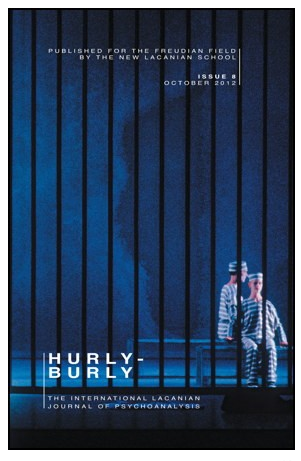
Hurly-Burly – Commentary on Six Selected Papers from the most recent issue

Image


Hurly Burly is available at  www.ecf-echoppe.com
from the NLS-Messager


The Contumax Child , by Francois Leguil

“[…] Lacan enters the debate opened by the first page of the Antimemoirs as someone who is very well informed. Although we shall have to come back to the invigorating nature of Lacan ’s critique, we may note that there is an indisputable moral integrity when, “hystericising” his own stance, Malraux asks, exhausted by his uncommon ordeals: “What is a man?”, because he doesn’t content himself with simply saying that it’s not the same thing as a grown-up. By default, Malraux deserves credit for not proposing that a man is a father and that being a father means having children.

            Since being a father is not a matter of knowing how to have children, does it mean knowing how to face up to the idea of losing them? This is not a way of getting out of this serious issue by some intellectual pirouette. Rather it takes us back to a long tradition that stretches from Golgotha to the nation’s sacrifice of its sons as inscribed on the monuments to the fallen. Recall if you will, although developing it here would lead us too far off track, that what Lacan had already been diagnosing before the war as the “decline of the father”[1] does not sit in the same line as this tradition which ultimately does no more than pass the consequences of the paternal metaphor onto the child, and does so because the Name-of-the-Father is a dead father. Lacan’s commentary in his Seminar on the famous Freudian dream, “Father, can’t you see that I’m burning?”, does not go in the direction of an exploitation of pathos, but rather turns towards the enigma of the desire of the Other.[2]

Francois Leguil raises questions about what constitutes a grown up, a child, a man and a father. These concepts, that are etymologically simple, are semantically charged and complicated. From Freud to Lacan, from religion to psychoanalysis, the author of the text attempts to answer some crucial existential questions “of being”.

Stella Steletari

_____________________________


[1] Cf. Lacan, J., “Les Complexes familiaux dans la formation de l’individu”, in Autres écrits, Seuil, Paris, 2001, p. 60: “a social decline of the paternal imago”.

[2] Lacan, J., The Seminar, Book XI, The Four Fundamental Concepts of Psychoanalysis, transl. by A. Sheridan, Penguin, 1994, pp. 57-60.

< >   < >   < >   < >   < >   < >   < >   < >   < >   < >   < >   < >   < >   < >   < >   < >   On Dominique Holvoet’s ‘The Pleasure of the Symptom’


“Psychoanalysis specifies itself by renouncing the attempt to resolve discontent [malaise] by eradicating the symptom”.

“Mr B turned to psychoanalysis because of a somatic symptom that medicine had been unable to treat – a hypertension that, by this point, had become so crippling that, when he came to see me ten years ago, he had not been able to work for a year. He was, he said, constantly tense, stressed, and deeply angry. This anger is a sort of stifled rage”.

In this clinical case Dominique Holvoet gradually unfolds the scenes and the crucial encounters which established the structure of the subject, as well as the formula of the fantasy. This case is about a subject that responds as a wounded man each time the Other of demand appears: “if you want me to fall, there you are!”.  Thus, he was captivated by an obsessional desire, the desire to kill desire – a death wish.

In the analytic experience “the symptom passes from its repetitive necessity … to the possibility of contingency, in other words the possibility of acknowledging the irreducible real of the symptom, offering a new trajectory for jouissance. The new status of the symptom, severed from meaning, the reconciliation with the real, opens to contingency. From this, a new responsibility is deduced for the analysand”.

The orientation of psychoanalysis is “… not to let oneself go on the side of meaning, but instead seek to make the well of meaning run dry in order get to the bone, which is the drive [pulsionnel]”.

Through this particular case, Dominique Holvoet designates the new status of the symptom, the symptomatic remainder after the revelation of the fantasy.


Despina Karagianni

 < >   < >   < >   < >   < >   < >   < >   < >   < >   < >   < >   < >   < >   < >   < >   < >   

 On Jean-Pierre Deffieux’s “On reasoning madmen” 

Jean-Pierre Deffieux’s “On reasoning madmen” analyses the seminal work of Paul Sérieux and Joseph Capgras for an English-speaking audience. Sérieux and Capgras were two major figures in French psychiatry whose 1909 publication,Les folies raisonnantes, which was considered a “masterly” work by Lacan, provides significant background to some important points in Lacan’s own understanding of psychosis.[i] Their analysis of “delusions of interpretation”, a concept that has since become famous in France but less well-accepted to psychiatry in the English-speaking world, emphasises what they call the “interpretative side” of psychosis over the paranoid or persecutory aspect.

With fine clinical observation, they focus on the role of interpretation in paranoia and conclude that the real kernel of paranoia is not ideas of persecution but an interpretative delusion. An interpretative delusion can be characterised in these terms. It begins with a dominant idea such as one of grandeur or persecution, or perhaps a mystical, erotic or jealous idea. There then ensues a reasoning and systematising process that successively crystallises a series of interpretations out of the phenomenon. Their analysis thus emphasises the role of the signifier itself, rather than the role of the signified or the content of the persecutory delusion.

Sérieux and Capgras contrast interpretative delusions (as the kernel of paranoia) with litigious delusions, taking the latter to be a distinct entity. Litigious delusions are linked to a precise external cause that the subject regards as prejudicial, and the subject is characterised by an idée fixe and by a manic commitment to working for “the cause”, as he understands it.

The task of separating out and refining these significant clinical entities was clearly an arduous business. The absence of hallucinations, mood disturbance, or signs of schizophrenia worried the authors to the point where they even wondered whether what they were describing really was a mental illness. And the precise identification of the interpretative delusion was difficult to make.

The article is accompanied by a valuable discussion of the strengths and weaknesses of Sérieux and Capgras’s contribution with Jacques-Alain Miller and other members of the École de la Cause freudienne.

Russell Grigg


[i] John Cutting and Michael Shepherd published a long excerpt from Les folies raisonnantes (pp. 5-43) in their excellent edited volume, The clinical roots of the schizophrenia concept (Cambridge: Cambridge Univ. Press, 1987), along with other seminal works from French and German psychiatrists.
 
< >   < >   < >   < >   < >   < >   < >   < >   < >   < >   < >   < >   < >   < >   < >   < >   

 On Jacques-Alain Miller’s “Psychotic Invention” 
 
With his customary clarity, Jacques-Alain Miller speaks here of the place of “invention” for the speaking-being, especially the psychotic. Miller draws our attention here not to the early Lacan, the Lacan for whom language is the death of the thing, the mortification of the body, with various symptomatic residues remaining in the neurotic symptom, but rather to a relationship of the speaking being and the body that is more prevalent now, today, in the 21st century.
 
At this moment of the decline of the Father, of Oedipus, speaking beings are less able to draw upon the “established discourses” to resolve problems faced in the encounter with a body, with language, with society, with the relationship to the Other. Indeed, in this moment where the Other does not exist, we are able to not only retroactively see that the Other of the past was only a semblant, but we are also in a situation where to relate to one’s body, to society, involves this very concept of “invention” that Miller highlights.
 
The paradigmatic example Miller weaves his talk around is the schizophrenic, the speaking being faced with a body that is no longer organized (as the psychiatrists say) by the established discourses, but that is instead an enigma, which the schizophrenic may respond to with an invention–this organ, or body part, is for this; this other organ for that; and so forth. In such a way, the organs–those parts of the body enigmatically present as “out of the body”–can be made use of by the schizophrenic. This is true too for the ultimate “out of body” organ, language itself. For here too, unable to “organize” language through the established discourse, the schizophrenic may too invent a way in which to make use of language.
 
Starting from this hypothesis, Miller touches on paranoia as the case of invention of a bond with the Other and melancholia as type of negative invention, or, what we may call the clinic of non-invention: the melancholic as the speaking being who has failed to make or sustain an invention. Miller develops the concept further with regard to a different failure of invention, in cases in which the speaking being cannot transcend the trauma of language with an invention.
 
All of this is illustrated by Miller with clinical vignettes and literary references. Adrian Price’s translation includes notes that direct the reader to the various references in Lacan and elsewhere that Miller makes in the talk and also will assist the English reader with the translation of difficult concepts from Lacan.

Tom Svolos

 
< >   < >   < >   < >   < >   < >   < >   < >   < >   < >   < >   < >   < >   < >   < >   < >   
 
 Guy Briole on Kraepelin – The Fragility of a Colossal Oeuvre

The era of the Other that does not exist and the rise of the ordinary psychoses has marked for us a clinical and epistemological threshold.  It is this perspective that underlies the interest of the collection of texts to be found in the latest issue of Hurly-Burly under the title of ‘The Malicious Other”- an Other, we could say, that has managed to evade or to shake off its bar.  For it now becomes possible to read what we could call the era of the Other as the product of a grand and systematic, even if somewhat outdated, delusion.


 
In the first of these papers taken from a 2008-9 lecture series at the ECF, Guy Briole demonstrates the interest of returning to the work of Emile Kraepelin, the founding father of classical psychiatry whose name is associated above all with the clinical concept of Dementia Praecox.  This association has perhaps served somewhat to mask Kraepelin’s influence in isolating and formalising the clinical concept of paranoia.
 
Briole’s reading of Kraepelin’s work is stimulating and instructive on many counts. The title of his paper – The Fragility of a Colossal Oeuvre – refers to the articulation he traces between Kraepelin’s life and work, based on a reading of Kraepelin’s autobiography, only released in 1976 to mark the fiftieth anniversary of his death.  Picking up on indications of Kraepelin’s own structure, Briole helps us to locate the subjective stake in constructing an ever more elaborate psychiatric taxonomy in an attempt to complete what he encountered as lacking in his initial entry into this field.
 
The various editions of Kraepelin’s Textbook on Psychiatry came to dominate the field of psychiatry much as the DSM does today.  Briole demonstrates the interest of following out the changing formulations and classifications of mental illness in the successive editions.  Perhaps even more intriguing, as Briole’s careful reading brings out, is the articulation between evolution and classification internal to the clinical concept of Dementia Praecox itself.
 
Following the successive editions, Briole shows how evolutionary criteria came to the fore in Kraepelin’s work, hence modifying the conceptual organisation of the diagnostic signs that made up the clinical picture of the illness.  It is now the question of the evolution of the illness, its conditions of onset and above all of outcome, that become the distinguishing characteristic.  Here Briole demonstrates clearly the ‘entirely original place’ assigned to paranoia in this conception, precisely as a kind of exception to the degenerative conception of schizophrenia.
 
Kraepelin’s extraction of the concept of paranoia from the field of the schizophrenias constitutes one of the fundamental roots of the construction of the Other at the heart of the classificatory endeavour of modern psychiatry.  It is here that we find his classical formulation of the concept of paranoia, foregrounding the purely psychogenetic origin of the illness around an initial delusional interpretation.  It is this definition of paranoia that Lacan will take as his point of reference at the beginning of his Seminar III on the psychoses.
 
Need I say anything more to indicate something of the interest of this text?  I urge you to follow Briole’s meticulous and informed tracing out of some of the questions at stake around this point.  I recommend above all the engaging discussion at the end of the paper by Jacques-Alain Miller and other members of the ECF that provides the link with the other texts brought together in careful translation under the title of The Malicious Other in yet another vital issue of Hurly-Burly.
 
Roger Litten
 
< >   < >   < >   < >   < >   < >   < >   < >   < >   < >   < >   < >   < >   < >   < >   < >   

Reading Clérambault- An Anatomy of Passions by Carole Dewambrechies-La Sagna


In this fascinating account of the intriguing life and meticulous work of Gaëtan Gatian de Clérambault, the psychiatrist and psychoanalyst, Carole Dewambrechies-La Sagna, gives us the opportunity to become further acquainted with the man Lacan referred to as his ‘only master in psychiatry.’ This text provides us with a detailed and insightful description of de Clérambault’s groundbreaking contributions to psychiatry on erotomania and mental automatism, emphasising the precision and perspicuity with which he differentiated the manifest phenomena from psychosis itself.


It seems that there is much more to what made de Clérambault the man that influenced Lacan more than any other in the field of psychiatry. He was an attentive and skillful interviewer of psychiatric patients and was the psychiatrist at the Special Infirmary of the Paris Prefecture of Police. During the twenty years he worked there, he issued more than twelve thousand certificates and it was he who had to decide on whether the prosecuted, who had often committed a passage à l’acte, would be hospitalized. He was also quite resented and targetted by the surrealists. This bachelor, de Clérambault, eventually committed suicide by shooting himself in front of his bedroom mirror. Certain aspects of his life will always remain unknown.


De Clérambault’s fascination with Arabic draping, of which he took thousands of photographs whilst in north Africa, seems to have been more than a mere artistic interest. His lecturing at the School of Fine Arts in Paris on drapery and the way fabrics fold depending on what is underneath is not simply a peculiar side of de Clérambault’s endeavours. His interest in movement, reflected in his fascination with drapery, is evident also in his meticulous study of psychotic phenomena, of their differentiation and the search for what underlies them, such as the role of mental automatism in delusional phenomena.


Reading Carole Dewambrechies-La Sagna on de Clérambault can only make one want to learn more about this mysterious figure and the immense contributions he made to psychiatry and, through Lacan, to psychoanalysis. Undoubtedly, de Clérambault can be counted among those, like Lacan, whose praxis left nothing the same in the field they dealt with. It seems that psychoanalysis owes him much more than meets the eye.
 
Iannis Grammatopoulos
 
Posted in Uncategorized | Tagged | Leave a comment
