



Online registration: www.europsychanalyse.eu
Enquiries : +32 (0)483 365 082 | info@europsychanalyse.eu
Online registration: www.europsychanalyse.eu
Enquiries : +32 (0)483 365 082 | info@europsychanalyse.eu
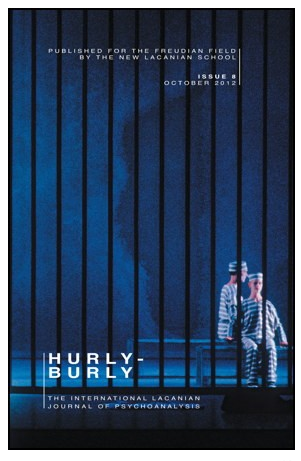
Hurly-Burly – Commentary on Six Selected Papers from the most recent issue
The Contumax Child , by Francois Leguil
“[…] Lacan enters the debate opened by the first page of the Antimemoirs as someone who is very well informed. Although we shall have to come back to the invigorating nature of Lacan ’s critique, we may note that there is an indisputable moral integrity when, “hystericising” his own stance, Malraux asks, exhausted by his uncommon ordeals: “What is a man?”, because he doesn’t content himself with simply saying that it’s not the same thing as a grown-up. By default, Malraux deserves credit for not proposing that a man is a father and that being a father means having children.
Since being a father is not a matter of knowing how to have children, does it mean knowing how to face up to the idea of losing them? This is not a way of getting out of this serious issue by some intellectual pirouette. Rather it takes us back to a long tradition that stretches from Golgotha to the nation’s sacrifice of its sons as inscribed on the monuments to the fallen. Recall if you will, although developing it here would lead us too far off track, that what Lacan had already been diagnosing before the war as the “decline of the father”[1] does not sit in the same line as this tradition which ultimately does no more than pass the consequences of the paternal metaphor onto the child, and does so because the Name-of-the-Father is a dead father. Lacan’s commentary in his Seminar on the famous Freudian dream, “Father, can’t you see that I’m burning?”, does not go in the direction of an exploitation of pathos, but rather turns towards the enigma of the desire of the Other.[2]”
Francois Leguil raises questions about what constitutes a grown up, a child, a man and a father. These concepts, that are etymologically simple, are semantically charged and complicated. From Freud to Lacan, from religion to psychoanalysis, the author of the text attempts to answer some crucial existential questions “of being”.
Stella Steletari
[1] Cf. Lacan, J., “Les Complexes familiaux dans la formation de l’individu”, in Autres écrits, Seuil, Paris, 2001, p. 60: “a social decline of the paternal imago”.
[2] Lacan, J., The Seminar, Book XI, The Four Fundamental Concepts of Psychoanalysis, transl. by A. Sheridan, Penguin, 1994, pp. 57-60.
< > < > < > < > < > < > < > < > < > < > < > < > < > < > < > < > On Dominique Holvoet’s ‘The Pleasure of the Symptom’
“Psychoanalysis specifies itself by renouncing the attempt to resolve discontent [malaise] by eradicating the symptom”.
“Mr B turned to psychoanalysis because of a somatic symptom that medicine had been unable to treat – a hypertension that, by this point, had become so crippling that, when he came to see me ten years ago, he had not been able to work for a year. He was, he said, constantly tense, stressed, and deeply angry. This anger is a sort of stifled rage”.
In this clinical case Dominique Holvoet gradually unfolds the scenes and the crucial encounters which established the structure of the subject, as well as the formula of the fantasy. This case is about a subject that responds as a wounded man each time the Other of demand appears: “if you want me to fall, there you are!”. Thus, he was captivated by an obsessional desire, the desire to kill desire – a death wish.
In the analytic experience “the symptom passes from its repetitive necessity … to the possibility of contingency, in other words the possibility of acknowledging the irreducible real of the symptom, offering a new trajectory for jouissance. The new status of the symptom, severed from meaning, the reconciliation with the real, opens to contingency. From this, a new responsibility is deduced for the analysand”.
The orientation of psychoanalysis is “… not to let oneself go on the side of meaning, but instead seek to make the well of meaning run dry in order get to the bone, which is the drive [pulsionnel]”.
Through this particular case, Dominique Holvoet designates the new status of the symptom, the symptomatic remainder after the revelation of the fantasy.
Despina Karagianni
With fine clinical observation, they focus on the role of interpretation in paranoia and conclude that the real kernel of paranoia is not ideas of persecution but an interpretative delusion. An interpretative delusion can be characterised in these terms. It begins with a dominant idea such as one of grandeur or persecution, or perhaps a mystical, erotic or jealous idea. There then ensues a reasoning and systematising process that successively crystallises a series of interpretations out of the phenomenon. Their analysis thus emphasises the role of the signifier itself, rather than the role of the signified or the content of the persecutory delusion.
Sérieux and Capgras contrast interpretative delusions (as the kernel of paranoia) with litigious delusions, taking the latter to be a distinct entity. Litigious delusions are linked to a precise external cause that the subject regards as prejudicial, and the subject is characterised by an idée fixe and by a manic commitment to working for “the cause”, as he understands it.
The task of separating out and refining these significant clinical entities was clearly an arduous business. The absence of hallucinations, mood disturbance, or signs of schizophrenia worried the authors to the point where they even wondered whether what they were describing really was a mental illness. And the precise identification of the interpretative delusion was difficult to make.
The article is accompanied by a valuable discussion of the strengths and weaknesses of Sérieux and Capgras’s contribution with Jacques-Alain Miller and other members of the École de la Cause freudienne.
Russell Grigg
Tom Svolos
The era of the Other that does not exist and the rise of the ordinary psychoses has marked for us a clinical and epistemological threshold. It is this perspective that underlies the interest of the collection of texts to be found in the latest issue of Hurly-Burly under the title of ‘The Malicious Other”- an Other, we could say, that has managed to evade or to shake off its bar. For it now becomes possible to read what we could call the era of the Other as the product of a grand and systematic, even if somewhat outdated, delusion.

|
FLASH! Lacan/Women/Miami Importante notice !! Call for Papers dateline extended Deadline to submit papers for Symposium “What Lacan Knew About Women” has been extended till January 31st, 2013. For details go to the web site: www.miamisymposium2013.org FLASH! Lacan/Mujeres/Miami Noticia importante!! Prorroga para el envío de textos Comunicamos a los interesados que la fecha límite para el envío de textos al Symposio se extiende hasta el día 31 de Enero 2013. Les recordamos consultar las indicaciones al respecto en la pag webw:ww.miamisymposium2013.org FLASH! Lacan/Mulheres/Miami Importante!! Prorroga chamada para envio de textos Comunicamos aos interessados que a data limite para o envio de textos para o Simpósio está prorrogada até o dia 31 de janeiro de 2013. Lembramos que as informações a respeito estão na página da internet: www.miamisymposium2012.org |
Register for FREE PARKING at

TRAFFIC REGULATIONS AND INFORMATION:
Avoid parking citations by reading
and obeying college parking regulations
Parking Administration
Office Location:
2700 W.W. Thorne, Houston Texas 77073
Library Building, Suite 111B
on the LSC–North Harris campus.
Hours:
Monday − Friday 8 a.m. to 5 p.m.
Email:
| Messager 509 – 2011/2012 |
| LQ Translations – A selection from Lacan Quotidien 219 1 septembre 2012 1 September 2012 From LQ 219 The Chronicle of Éric Laurent The Profound and Enduring Crisis of the DSM Zone The very serious journal La Recherche, the voice of French scientific laboratories and French-speaking rival of Scientific American,strangely entitles its June 2012 issue: “Mental Illness: The Fraud”. The subtitle reads: Why one European in three is declared mentally ill”. The figures come from a study published in September 2011 in European Neuropsycho- pharmacology. These figures were obtained through a very DSM-style methodology. Academics from Dresden gathered together data from epidemiological enquiries conducted over thirty years in thirty different countries (27 from the EU as well as Switzerland, Iceland and Norway). They took into account 27 mental illnesses in a surprising list that groups together anxiety disorders and insomnia with dementia and ADHD (Attention Deficit Hyperactivity Disorder). This combination immediately bore fruit: 38% of the European population presents a mental illness. Even the WHO, which has a very broad view on mental health, which it defines as a “state of well-being”, sees itself being led to temper such results. Its mental health expert in Brussels, Matt Muijen, comments: “The figure of 38% is an indicator of stress in our society and not only of psychiatric disorders”. This extension-dilution of the clinic by way of the disorder, the syndrome and the item is characteristic of the contemporary epidemiological movement where one doesn’t really know what one is measuring. Why, however, speak of fraud? La Recherche denounces the willingness of the DSM-5 (see the Chronicle in LQ no. 208) “to continually extend the territory of mental illness”. Sylvie Sargueil, journalist and doctor, supports the theses of Roland Gori and Christopher Lane on the medicalisation of human existence and emotions. She shows the limits of the DSM pseudoscience and draws a conclusion on the fabrication of so-called illnesses by the specific drugs that are proposed by the industry. “This scientific illusion, in effect, reassures a population that is claiming answers and simple solutions, and largely benefits the pharmaceutical industry”. Finally, she warns against “the too frequent recourse to drugs of which the under-evaluated relationship between benefit and risk could lead to a new sanitary scandal”. In response to this denunciation of the inflation mechanism inherent to the DSM zone, Christan Lajoux, President of the French union for the pharmaceutical industry, denounces those “who are doing business out of the systematic denigration of drug companies” and rejects any direct link between industry and marketing authorization. “To believe that they could be under the influence of the industry is to accord no importance to the eminent experts in these national and European agencies”. Obviously, saying this in the times of the Mediator trial does not have all the credibility one would wish for. The weight of the conflict of interests continues to hover sufficiently for the journal to use the title “fraud”. Allen Frances, who readers of Lacan Quotidien have come to know (LQ 207) as the Chair of the Task-Force for the DSM-III and the DSM-IV and who unceasingly criticises the Task-Force Chair for the DSM-5, comes to the rescue of the industry in order to condemn all the more the errors of the new Task-Force. “Numerous critics are formulating the abusive hypothesis that the DSM is working for the pharmaceutical industry. This is false. The errors come rather from an intellectual conflict of interests; the experts always over-estimate their preferred domain and want to extend its perimeter, to the point where daily life problems are wrongly qualified as mental illnesses”. The same as he rejects the pernicious influence of Big Pharma as being the cause, Frances continues to think that the foundations of the DSM are healthy. “Psychiatric diagnosis was a professional embarrassment before the publication in 1980 of the DSM-III. Before that, diagnosis was very heavily influenced by psychoanalysis, psychiatrists rarely agreed upon diagnosis and no one really worried about it anyway. The DSM-III raised great interest amongst professionals and the public by specifying the exact criteria for each disorder… The fourth edition of the manual, published in 1994, tried to contain the diagnostic inflation which had followed the preceding edition. It succeeded on the side of adult disorders but did not succeed in anticipating or in controlling the trend of over-diagnosis of autism, attention deficit disorders and bipolar disorders amongst children, which have been produced since then”. He refuses to see that it is the very mechanism of the dismantling of the great frameworks of psychopathology, their reduction to simple items, empirical, clearly observable and without any equivocation, that is in itself inflationist. The empiricism of disorders, proud of its empiricism, went liberated from any hypotheses other than a biological foundation to be discovered one day, is like a common epidemiological currency without governance. Without any “theoretical” discussions on what is a mental illness and what is not, the only debates are about the quantity of items to control. Allen Frances is simply counting on good regulation to solve the DSM zone problems. When he himself directed the DSM Committee of the American Psychiatry Association (APA), he considers that he was doing the job, but that now it no longer works. He therefore wants to take the DSM out of the hands of the APA in order to confide it to an independent agency linked to the Ministry of Health or to the WHO. The miracles expected from regulation by independent agencies constitute the most widespread belief amongst the great health bureaucracies. It is without doubt an illness to add to the catalogue of disorders, an obsession of those in charge. The DSM zone will need more radical measures in order to constitute a reliable and responsible governance, which will be able to take into account the perverse effects of classification and the adverse effects on the population it encompasses. These perverse effects are particularly noticeable at the intersection with the juridical field. The DSM is not, in effect, merely a classificatory system like any other. It authorises obligatory follow-up care to insurance companies and is used as a directive text for justice in order to determine psychiatric commitment. Because of this juridical function, the criteria that are maintained in order to define the category of “sexual disorders” are particularly numerous. The old stigmatising and out-dated identifications, like “homosexuality”, were removed from the DSM-IV in 1994, and the invention of new categories producing effects of segregation are interesting to follow in detail, which is what Allen Frances is doing, in one of his chronicles for the Huffington Post, which can be found on the website of the US edition. The working group for these themes proposed three new categories to the DSM-5: “hyper sexuality” (Sexual Addiction), “rape” (Paraphilic Coercive Disorder) and the corruption of a minor (Statutory Rape or Hebephilia). These three categories were eventually rejected because they introduced confusion at the limit between mental illness and occasional crime. Their perverted legal consequences, the increased possibility of abusive commitment, were particularly predictable.The USA Supreme Court has, in a recent legislation, reminded us that the distinction to be made between an offense or a crime and an illness must be preserved, otherwise subjects will be sentenced to psychiatric commitment even before committing any criminal sexual act, right from the first offense. Also, the definition of paedophilia as: “Over a period of at least 6 months, an equal or greater sexual arousal from prepubescent or early pubescent children rather than from physically mature persons, as manifested by fantasies, urges, or behaviors” creates the problem of distinguishing between sexual predators who attack no matter who, including children -who are an easier prey- and a genuine fixation. Frances pleads for the substitution of “preferred or obligatory” by “”equal or greater” of which he denounces the false idea of measure, conveyed by a mathematical vocabulary. By adding the “early pubescent” category, up until the age of 14, the DSM-5 thus extends the number of subjects who enter into the category of “paedophile”. The Task-Force leaders deny this, but the medico-legal problem subsists and is of importance. It is not only the retained disorders that are caught up in an inflationary spiral: 100 pathologies in the DSM-I, 400 in the DSM-IV, maybe 500 in the DSM-5. The mnemotechnical rule is simple: One takes the number of the DSM and multiplies it by 100 in order to get an idea of what one is going to find as items. By the mechanical application of definitions, of which the inclusive categories are increasing because we do not see clearly why, without theoretical discussions, we would limit them, more and more subjects will then fall under the scope of medico-legal decisions. The DSM zone intends to manage the field of mental health according to a system that proposes classifications in the form of hypotheses which incorporate the current state of knowledge recognised by a consensus at the moment when it formulates them. In fact, it is a population management instrument that cannot ignore the consequences of its classificatory authoritarianism going forth masked as false science. It is not the “scientific” hypotheses that the system put in place tests. It tests the effect of segregative standardisation that it produces, and the social tolerance of this effect. The number of “paraphiliacs” (ex-perverts), on the increase from one DSM to the next, is a particularly sensitive subject, but all discussion on the eventual decrease in the number of autistic subjects testifies to this just as much. The method, in detail, leans upon the logic of the inclusive or exclusive or. In the DSM-IV, the Asperger’s category, in its first criterion A, enumerates four items, of which only two are sufficient in order to be inscribed within this category. In the DSM-5 there are only three items (deficits in social-emotional reciprocity, in the use of non-verbal communicative behaviours, and in relationship development). But it is necessary that the three criteria be present at the same time. The criterion A is completed by the criterion B (Stereotypic Movement Disorder). Yet, it is necessary to cross out one of the two criteria in the DSM-IV and both of them in the DSM-5. The number of possible combinations is mathematically very limited. It has been calculated that with the DSM-IV there were 2688 combinations to obtain a diagnosis of autism. There are no more than six with the DSM-5. There is then a mechanical reduction of the number of cases inscribed in this category. Yet, diagnosis has a legal value in order to give access to programs and care especially reserved for autistic subjects. Doctor Volkmar, of the Yale Child Study Center, (cf. Chronicle in the LQ no. 194) calculated that only 45% of subjects who qualified as autistic in the DSM-IV will be carried over in the DSM-5, in all of the categories of the spectrum. For the specific Asperger’s disorder spectrum, the figures reach 75% of subjects who don’t qualify as such. There is now evidently an acute contradiction between the claims of testing scientific hypotheses on the definition and the nature of autism and the disastrous effects at a medico-legal level of the management of populations. Without the diagnosis of Asperger’s disorder, a child can no longer have access to “inclusive” teaching programs. He will be left outside by sheer classificatory arbitrariness. This movement, brutally deflationist, reminds us of the management of the financial crisis. After a period that was very tolerant towards the inflation of categories admitted in the DSM, between 1994 and 2010, we are hitting the brakes, regardless of the cost for the population. The consequences will be the same as for the population excluded from the work force by brutal deflation. The number of paraphiliacs committed and the number of children excluded from care systems are the two sides of the coin of a scientific authoritarianism which people no longer trust. On this point, Allen Frances is making a mistake. The DSM system was unhealthy from the very beginning. The current derive of Task-Force leaders, who believe they have reabsorbed psychiatry into neurology and measure the intensity of mental illness “as one measures blood pressure and cholesterol” was already germinating in the initial project. The crisis in the DSM zone will be enduring and profound. Trust no longer seems to be able to be restored without strictly “theoretical” discussions about the dangers of confusing levels between uses and functions of the classificatory language which is spoken in this zone. Translated by: Frances Coates-Ruet |
| Messager 511 – 2011/2012 |
| Publication in English: “Serial Killers Psychiatry, Criminology, Responsibility” by Francesca Biagi-Chai 6 September 2012 New in Paperback Serial Killers Psychiatry, Criminology, Responsibility Francesca Biagi-Chai Translated by Veronique Voruz and Phillip Dravers |
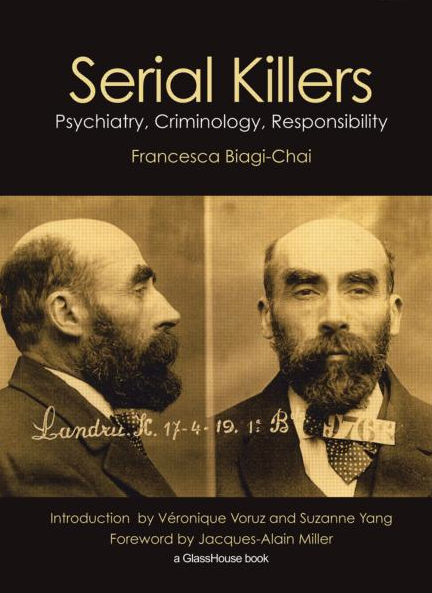
Francesca Biagi-Chai’s book – a translation from the French Le Cas Landru – tackles the issue of criminal responsibility in the case of serial killers, and other ‘mad’ people who are nonetheless deemed to be answerable before the law. The author, a Lacanian psychoanalyst and senior psychiatrist in France, with extensive experience working in institutional settings, analyses the logic informing the crimes of famous serial killers. Addressing the Landru case, as well as those of Pierre Rivière and Donato Bilancia, Biagi-Chai casts light on the confusion that pervades forensic psychiatry and criminal law as to the distinction between mental illness and ‘madness’.
The book includes a Foreword by the renowned psychoanalyst, Jacques-Alain Miller, and an introduction by the translators on the question of insanity before the law in the US and in the UK, which considers the pertinence of Biagi-Chai’s argument for forensic psychiatry, for criminal law, and for the increasing contemporary focus on the assessment of dangerousness and risk-management strategies in crime control practices. Learn more…<http://tandf.msgfocus.com/c/1agmFfLfHnQ6I8mEbfve2jEg0>
Paperback: 978-0-415-68167-4: £24.99
Click here to buy your copy today <http://tandf.msgfocus.com/c/1agmFCfnhDeBHWYFg7rNPuNm9>
| Messager 518 – 2011/2012 |
| ‘Knottings’ Seminar of the NLS 2012
11 September 2012 |
KNOTTINGS 2012-2013
| Psychoanalysis and the Psychotic Subject From Forced Invention to Belief in the Symptom Concept of ‘Knottings The ‘Knottings’ Seminar of the NLS, has the function –as its name suggests- of weaving the working ties within the whole of the School, in a combinatory way that pierces bilateral ties. Organised by the Executive Committee of the NLS, it brings together colleagues from the 5 Societies, plus the Polish groups. The axis of the Knottings is the Congress of the School, which this year will take place in Athens on 18 and 19 May 2013. The Knottings allow other voices of psychoanalysis in the Lacanian way–which is one-, to be heard. Their richness lies in this confrontation of languages at the heart of the most heterogeneous of the Schools of the WAP. This diversity is homologous to our object’s matter itself. The title, the argument, the bibliography, Eric Laurent’s intervention in Tel-Aviv, are to be published to the rhythm of the preparation of the Congress theme, in a continuous work-in-progress. Circulated via NLS-Messager, they will be published on the NLS website:http://www.amp-nls.org. The website, which is undergoing complete renovation, will offer new tools for this work. In each location, three papers will be presented and discussed: a theoretical introduction by a member of the Executive Committee, two clinical presentations, by one member of the local group and by a guest from another group. The President of the local group is responsible for chairing and reporting. Programme You will find below the programme for the next three ‘Knottings’ seminars. The programme for the other Knottings seminars scheduled for 2013 will be announced later. For the Executive Committee of the NLS Dominique Holvoet and Nathalie Laceur 15.09.2012 – ASREEP-NLS Location: Geneva Introduction: Dominique Holvoet (EC) Clinical Cases: Lieve Billiet (Kring voor Psychoanalyse van de NLS); Beatriz Premazzi (Asreep-NLS) President: Renato Seidl 24.09.2011 – Hellenic Society of the NLS Location: Athens Introduction : Dominique Holvoet (EC) Clinical Cases: Sharon Zvili (GIEP); Helene Molari (Hellenic Society) President: Epaminondas Theodoridis 27.10. 2012 – Circle of Warsaw & Circle of Cracow Location: Poznan Introduction: Yves Vanderveken (EC) Clinical Cases: Anna Pigkou (Hellenic Society); Alina Henzel-Korzeniewska (Circle of Cracow) President: Grazyna Skibinska |

 houstonfreudianfieldlibrary
