
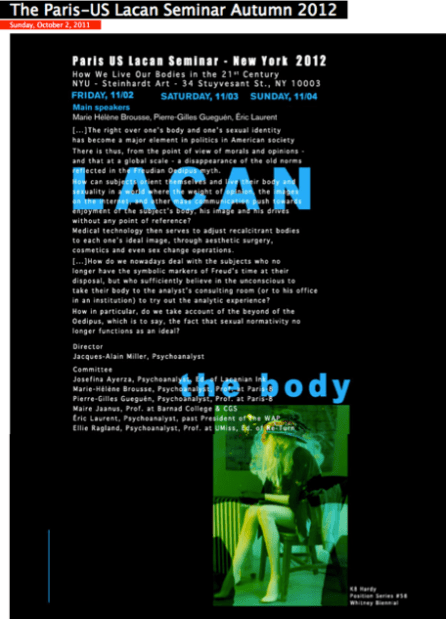
Seminars on Psychoanalysis Studies # 9
Houston Freudian Field Library NEL-FIBOL Member.
https://houstonfreudianfieldlibrary.com/
Invitation
Seminars on Psychoanalysis Studies # 9
Bilingual English-Spanish. Free admission
I-Reading Seminars.
Discussant: Carmen Navarro-Nino. AP. WAP member.
Location: Lone Star College, Fairbanks Center, Conference Room # 201
14955 Northwest Freeway (290) Houston, Texas 77040
Schedule update: Every other Wednesday from August to December 2012
Time Dates
|
1-Readings about:” “Childhood and Adolescence” Wednesdays 12:30 to 2:00 pm. |
August 29 September26 October 10 November 7 December 5 |
|
2-Readings about: “Discourse and The Real-RSI“ Wednesdays 6:30 to 8:00 pm. |
September 12 October 24 November 21 December 12 |
Readings on Psychoanalysis cultural and clinical connections.
-Readings from Lacan’s “Ecrits, A Selection by Jacques Lacan” (1901-1981). This book is a selection from “ECRITS”
originally published in French by Editions Seuil, 1966.
Texts: Books 3, 7, 11, 20, 23 The Seminar of Jacques Lacan.
–Jacques-Alain Miller. The Experience of The Real in The Psychoanalytical Cure. Paris, 1999. Spanish edition, 2003.
-Sigmund Freud. Texts Selection. Esthela Solano-Suarez, Eric Laurent, Texts Selection.
Open Participant Readers:
Carmen Navarro-Nino.
Marianela Bermudez-Cuns.
Valeria Ravier.
Leila Toshie Yabiku.
Edgar V Marín.
Academic coordination:
Luis F Nino G, Marianela Bermudez-Cuns.
II – Reading Seminar: “Analytic Practice in the Hypermodernity”.
Discussants: Mercedes Acuña. Mercedes Negrón.
Frequency: Every second Tuesday of the month.
From 4:00 pm to 5:30 pm.
Location: TBA
Lacan, Jacques. Book XVII “The Other side of Psychoanalysis”. Book X “Anxiety”
Book XVI “From an Other to an other”. Miller, Jacques-Alain Comandatuba Conference. IV AMP Congress 2004, Brazil.
“The Other does not Exist and Their Ethics Committees”, 2005. Laurent, Eric. Text Selections
III– Other activities:
·Lacanian Cartel: Questions about the Symbolic. Open Meeting.
Location: TBA. Info: https://houstonfreudianfieldlibrary.com/
——————————————————————————————————–
Important Note:
For more information about the World Association of Psychoanalysis, Lacanian Orientation and Analyst Formation visit:
http://www.causefreudienne.net/
http://www.wapol.org/en/index.html
http://www.wapol.org/en/Template.asp
The Freudian Field was created by Jacques Lacan in February 1979.
Houston Freudian Field Library” in-formation. NEL-FIBOL Member. Lacanian Orientation. Open every other Wednesday 1.30pm to 3.30pm. By appointment.
12026 Canterhurst Way. Houston, Texas 77065Contact us at: Telefax : (+) 281 897 8295 / email:Carmennavarro11@hotmail.com
Posted in Uncategorized
Leave a comment
From LQ 208

The Chronicle of Éric Laurent
Starts of the Clinic and the Dead-End of Neuro-Multiculturalism
The busiest forum on the current debates on the clinic has just taken place, from the 5th to the 9th of May in Philadelphia, with a well-chosen name. It was the 165th Congress of the American Psychiatry Association. The title and slogan of the Congress was: Integration. Between the General Practitioner and the hospital in a broader sense, how can psychiatric care be integrated into a system which is acquainted with the difficulties of public and private management networking, distinguished within different Health Maintenance Organisations, but not integrated within a unified health system? The system is also aware of the excessive prescription of psychotropic drugs by General Practitioners and the difficulty in integrating civilian and military psychiatry in the treatment of war veterans presenting post-traumatic syndromes.
Such a Congress represents 10,000 participants, with a profusion of everything: plenary sessions, workshops, round-tables, lectures, symposiums, guest speakers, key-note speakers, and a myriad of posters. It opened with a conversation between Aaron Beck, Emeritus Professor of Psychiatry in Pennsylvania, and Glen O. Gabbard, Professor of Psychiatry in the States of New York and Texas, on the points of convergence and divergence between cognitive and psychodynamic psychotherapies. Let it be clear: no slides, no texts, just speech, supreme luxury.
The program is 192 pages long, without counting the hundreds of poster pages. It begins with a 30 page Disclosure Index, in which the speakers who have had any action or engagement with pharmaceutical laboratories must declare them. It is also necessary that the speakers who have nothing to declare do so. The program evokes all that is said in the psychiatric field. It is very difficult to orient oneself in this democratic labyrinth, in which, nevertheless, there is a very strict pecking order. For psychoanalysis, it is easy; there is only one presentation in the program’s index, entitled: “Adolescence and childhood development reorganisation: A neuro-psychoanalytic model”. All in all, it is useful to refer to the specialised articles that appeared in the New York Times and the Washington Post in which Benedict Carey and N. C. Aizenman have resumed the main points.
In this Congress, there was a lot spoken about the consequences of the reorganisation of the clinical field, under the influence of the DSM-5 to be published in May 2013, and of the importance of this reorganisation on “integrated care”. The upcoming master is polarising the field already. The 162 member committee in charge of finalising the document has made public its strategic and highly political decision of renouncing two novelties which had made a scandal.
One of them was the new category of “attenuated psychosis risk syndrome”, which concerns identifying young people at risk of developing later on serious psychosis whilst suffering from minor hallucinations or delusional ideas. The greater risk was that they would be heavily medicated, at the price of unwanted side effects. Psychiatric classifications cannot offer themselves the luxury of admitting “ordinary psychosis” because it would be necessary to medicate them in an equally ordinary way. It also renounced to the new “Mixed Anxiety-Depressive Disorder” which opened up the way to placing the entire population under anti-depressants. We must not believe that these categories have been abandoned, because they have been proposed by the most fundamentalist sector of bio-psychiatry. They consider that pathology is probably one vast continuum in which clinical entities are nothing but unfounded rhetorical artifices, and that it would be better to distinguish degrees of intensity. These categories will then be placed in an ad hoccategory, which we have learnt about through HAS literature: “Disorders requiring further research”. Nevertheless, it is a failure of the Big pharma lobby. Allen J. Frances, President of the committee that developed the DSM-4, now at the head of the opposition movement against diagnostic extensions, is delighted about this drawing back but he underlines that there are still a certain number of categories likely to provoke adverse effects, like the “minor neuro-cognitive disorder”, or the too easily accepted “addiction”. He declares to Aizenham: “The implications go much further that anything that you have ever imagined (…) Add a new symptom and suddenly tens of millions of people who have no diagnosis up until now wake up with this one and will be bombarded by television adds proposing medical treatments… Instead of curbing the problem, the DSM-5 will open up the floodgates even more”. The fact that they are obliged to add a paragraph distinguishing sadness and the symptoms accompanying significant loss, which may resemble depression but isn’t, is hardly reassuring.
There is one point on which the DSM-5 committee made the decision of drastic reduction. It is on autism, where they propose to suppress “Asperger’s Syndrome” and “Pervasive Development Disorder Not Otherwise Specified”. The effects of this decision have been the subject of lively debates. A study from Yale considers that the number of autistic subjects will decrease by half, while another study presented during the Congress considers that this will not change much, as far as the current figures are concerned. As diagnosis is essential in order to access government benefits, the Director of the Centre of Childhood Studies of the Yale School of Medicine hopes that the last hypothesis is true and that the situation will remain stable, but he then wonders what is the point in touching it. However, one of the DSM-5 committees, whose declarations we have reported in another chronicle, (“Autism: Epidemic or Ordinary State of the Subject”, in LQ no. 194 of the 10th of April) was very clear on this point. It is a question of changing the definition in order to “stop the autism epidemic”. One deduces then that this will not be easy and will give rise to claims and predictable debates.
The entire Congress of psychiatry was thus subjected to the tension existing between extension and contention. On the neuroscientists’ side, liberated from clinical problems and based on the objectivation of neurobiological variations affecting autistic subjects, they voluntarily free themselves from limits. Laurent Mottron’s article published in the last issue of “Cerveau et psycho” is exemplary in this regard. “Everything that we know today about autism leads us to see in it a different brain organisation rather than an illness” and that “it is probable that the “autistic spectrum” (…) represents a large part of the population (…) A recent Korean study showed that an individual can correspond to the behavioural criteria of autism as defined by the scientific community, whilst being totally autonomous and without his peers noticing anything. This would be the case for more than 2% of the general population, on top of the 1% for whom the difference is evident. Are these individuals “autistic”? They are, if we define them by a particular behaviour; they are not, if we define them by an illness.
Here we are then at 3%, one child in thirty, which is to say, with the gender dissymmetry, about one boy in twenty. This “considerable population”, according to this perspective, must be welcomed despite its difference and have access to knowledge through their own means, in a way that optimises the performance of its members. It is only then that we will know what autism is, because for the moment “we do not know how autistics would behave if they had access, from birth, to the right information.” The autistic community is explicitly compared to the slave community of the colonial era. Cognitive studies concluded for a long time on the supremacy of western populations, when it was nothing more than exclusion from knowledge. It is not about adapting the autistic community to a lifestyle of the majority or wanting to efface their difference with artificial behavioural treatments. In the Canadian tradition of inter-community respect, Mottron proposes a neuro-communitarianism: “The demand to adapt oneself to the majority, founded upon the logic of strength in numbers, is the warfare’s logic, or electoral logic. It should not concern the neurobiological differences that exist within the human family”. It is about finding the right place for the members of this community. Mottron really does not t like psychoanalysis and never misses an opportunity to make it known, with a lack of subtlety worthy of praise. Nevertheless, the psychoanalytic objection to the community of subjects gathered under a common label should be of interest to him. What we can say about one subject of a given type is of no use for another subject. What needs to be aimed at is not the community, but the particularity. This is underlined by TEACCH practitioners, like Bernadette Rogé, Professor at Toulouse-Le Mirail University, interviewed by Mediapart, who says we must take into account the particularity of autistics: “their willingness, their motivation, their particular sensory and cognitive functioning, which demands a lot of adaptation”. Or even, in the “Denver model” where play and learning are combined in a “positive emotional interaction”, “every domain is worked upon: language, adaptation, motor functions… in a much more natural and spontaneous way”. Beyond objections in favour of singularity, neuro-communitarianism comes to a dead-end due to its vocation of extension without any limits, beginning from behavioural traits, thus sharing the same neurological malfunctioning not otherwise specified, which is no longer a symptom.
In the same issue of Cerveau et psycho, Franck Ramus, another supporter of the disappearance of the clinic in favour of neuro-scientific evaluations, dreams of another proliferation. He brings forth l’hubris from the French politician Fasquelle who seeks to legislate on the treatments of autism. He goes even further, calling for the creation of a “National Evaluation Agency of Psychotherapies” by leaning on the argument that we know so well since the Accoyer Amendment: the juridical void. “Non-pharmaceutical treatments are not subjected to any obligatory evaluation, and are put onto the market with no form of control”. He very much sees himself as being the one to watch over the prescription of any obligation, the validation of established treatment lists, updating, as if competent in the entire psychical field. A truly complicated project. We can see the contradictions into which the AFSSAPS has blundered, now the ANSM, when its domain was already well defined: that of biological studies. We learnt of the failure of the regulatory project for the title of Psychotherapist (the decree of May 7th 2012 modifying the decree of May 20th 2010 with regard to the use of the title, cf. the communique in Lacan Quotidien of 9th May). One easily imagines the dead-end in which this new Agency will be getting lost.
Franck Ramus boasts about not being a clinician and of only being orientated by “science”, that is to say, the horizon of the statistical series of “evidence based medicine”. He is the Research Director of the CNRS (National Centre for Scientific Research) in France, and also a member of KOllectif January 7th, a support group for the Le Mur (The wall) documentary, and “a reflection group on the theme of therapeutic practices for autistic children, so that they may progress despite the resistance of many psychoanalysts”. The leader is Brigitte Axelrad, Honorary Professor of Philosophy and Psycho-Sociology, author of a book on “The Ravages of False Memories” (2011) who sustains very different theses to those by Jean-Claude Maleval1 on the causes of the “false memories” epidemic. In this collective, we also come across Yann Kindo, Professor of History and Geography, a rationalist militant whose blog, housed by Mediapart, fires away at psychoanalysis and recommends civil disobedience in order to “become a voluntary planter of GMOs”. On May 10th 2012, loyal to the recommendations of the “Manifesto for an evidence-based psychiatry and psychology” produced by KOllectif, Franck Ramus published, in another blog housed by Mediapart, an article proudly entitled: “Psychical suffering is neither evaluable nor measurable”. My eye! He reaffirms there his faith in the validity of statistical investigation to measure everything that is psychical. However, in the dossier consecrated to autism in the April 2012 issue of Sciences et avenir, he could not hide his surprise over the little impact that the KOllectif “Manifesto” had when he had wanted to have it signed as a petition in his circle. The cause of this would be simple: “According to him, a lot of young psychiatrists would consider it too risky for their career to say out loud what they think deep down about French psychoanalysis”, the S&A dossier reports. We have here two links of the chain of the subjective field. Everything that is psychical can be measured, and if something unpredictable appears, this is the result of a psychoanalytic conspiracy. The fact, the evidence, is that the “manifesto” was a flop. The rest is interpretation.
Translation: Frances Coates-Ruet
(1) Maleval, J.C. Etonnantes mystifications de la psychotherapie authoritaire. (The astonishing mystifications of authoritarian psychotherapy)
Posted in Uncategorized
Leave a comment
From LQ 210

From Civilisation to Globalisation I
Agnès Aflalo
Since the end of the Second World War, the world has changed. And this change can be put into order starting from the concept of discourse as Lacan formalised it1. The progress made by the discourses of capitalism and science allows us to grasp the effects of it.
The Capitalist Discourse and its Subject
As for every discourse, the discourse of capitalism account for a loss of jouissance that is impossible to recover. This loss of jouissance is always perceived as a theft, and its return is always located on the side of the Other, the Master. Freud describes the same libidinal displacements within the circuit of the drive. But Marx was the first to knot these two unknown displacements of the libido, which made Lacan say that he is the inventor of the symptom. This symptom as it was discovered by psychoanalysis in its beginning is still valid today. Scientific obscurantism in the 21st century may very well decide to ignore it, which does not prevent it from existing.
This capitalist discourse rejects the first loss of jouissance and suspends its return. The symptom ceaselessly reiterates this double movement of refusal of the loss and its return so as to totalise it, which it does not miss. This is the fundamental stereotypy of the symptom. This discourse thus accomplishes a foreclosure of castration. In Freud’s era, civilisation and its discontents centred itself essentially on loss, whilst today, globalisation centres itself especially on the second time of the return of jouissance without limits. For Lacan, the discourse of the unconscious must be clarified with this capitalist discourse.
Capitalism has allowed a new subject to emerge. He is very much an effect of language, but is no longer subjected to the master signifier which is repressed. That is to say that the signifiers of the social Other no longer identify him. We particularly observe this with regards to homosexuality or autism, current symptomatic stakes for the DSM. These subjects refuse the segregation induced by the dominant discourse which classes them respectively within perversions or psychoses. These worn-out master-words no longer index the real that is at stake and are rejected.
More generally, the capitalist subject refuses the authority of the Master. And “the authority crisis” names this phenomenon of the decline of the Master at every level of democratic societies. However, the function of the master-words is also the mortification of jouissance. When the master-word is repressed, the mortification of jouissance – castration – no longer operates. The consequence of this at the level of the body is decisive. There are no longer any limits upon the production of the object (a) surplus-enjoyment. This is exploitation to death. The reason for this is that it is not only having that is concerned, but also being. The subject is even more abandoned to the authority of the absolute master in so far as he is not identified to any particular master. Death is the only limiting principle for jouissance when castration no longer operates.
Capitalism has known two major modifications during the last thirty years. Firstly, it has become globalised. Effectively, since the fall of the Berlin wall, communist nations have come together under the market economy. It is then legitimate to say that there is no longer civilisation, but globalisation in which subjects are suffering particularly from addictions without any limits founded upon the unlimited return of the surplus-enjoyment. Next, capitalism has become “scientific” – financial capitalism should be called scientific capitalism. Its subject is the generalised proletarian, because nothing allows him to uphold a discourse, as the phenomenon of the ‘Indignados’ shows us. It is no longer necessary to place the proletarian in factories in order to extract the surplus-enjoyment from him. The financial crisis of 2008 showed this, it suffices to lure him by means of investments which have the appeal of casino winnings, reduced to a few opaque mathematical equations (securitization) in order to transform him into a homeless person at the first crisis of confidence. The phenomenon of solitude and its autistic satisfaction gives an idea of the worldwide expansion of this phenomenon.
The Scientific Discourse and its Subject
With science, the master-signifier no longer functions either. What is more, science reduces the effect of a series of functions of discourse: The signifier is reduced to its effect of letter –mathematics only uses letters– and the object (a) surplus-enjoyment is rejected; there, the dialectical work of truth is no longer possible because the subject’s division is neutralised. Castration then no longer operates. Truth and the singular real of libido are disconnected. The only real at stake in this discourse obeys universal laws, and not a singular cause: It is the real of the organism which is to be distinguished from that of the body. The analytic discourse has shown, in effect, since its beginnings in the 20th century, that the body is always a speaking body, which evidently is not the case of the organism which is a matter of science.
The subject of science dates from the cogito and is nothing other than a void. It is a pure subject. It is decisive to see this, because science no longer needs to turn to the intuition of the body. It does without the body. Now science operates solely on the organism and its real. This pure subject of science does not exist anywhere, but it is necessary to grasp that science veils the part of the subject that expresses itself in the fantasy and which is correlated to the object (a). The subject thus neutralised in his division becomes universalising. He increasingly lends himself to the logic of classes. But the liberation from the body provokes a disjunction between the body and the object (a), between the universality of the body and the particularity of the object (a). The object (a) is an empty set, it is therefore incorporeal. When it is rejected, it gallops off all by itself, separated from the body. But it is also ready to recapture the bodies again at the first opportunity. This is the case of every natural or industrial object (a). This object (a) is not inert. It is a bit like a black hole, it is an object “that wants”. Let us take the example of the object (a) gaze and its relation to the body. The gaze increasingly captures the bodies in our societies under surveillance, whether outside on the street by way of increasingly numerous cameras, but also in the home by way of television or computer screens without counting mobile telephones and other mobile tablets transportable everywhere, all the time. In other words, this object (a) has on the body the effect of a push-to-enjoying, from which it cannot be separated for long. When it returns towards the organism, it then manifests itself in all sorts of addictions which make up contemporary symptoms. It is the same insatiable gaze object that scrutinises the private life of everyday people through shows of the so-called reality TV; it is also this object that feeds upon the vicissitudes of the private lives of our modern masters whose mediatisation is demanded without delay. But when the media mirror no longer provides a veil, the awaited ideal does not appear, and disappointment is then assured. The ideal of the normal man is without doubt in the spirit of our times. However, this fiction which gathers together also contains within itself the germ of ulterior dispersion. Effaced for only a short time, it does not miss re-appearing and manifesting itself in particular as the small difference to which each one holds on, as though to his most precious possession. Let us add that the subject of science, liberated from the body, is also a subject without shame. Following the same principle, the emancipation of the oral object provokes worldwide epidemics of obesity or anorexia, from the earliest age.
Science and capitalism are united for better and for worse. They have engendered the most important progress of humanity. However, the deep modifications that they impose on discourse also generate new forms of discontent. Evaluation has come to reinforce this globalised discontent. Contemporary discontent knows no traditional frontiers and this is why it is justifiable today to speak of globalisation and no longer of civilisations.
Translated by Frances Coates-Ruet
Posted in Uncategorized
Leave a comment
nls-messager 484b / Two Congress favorite
From NLS
A plural School with the School-One,
By Jean-Pierre Klotz – member of the NLS
By Jean-Pierre Klotz – member of the NLS
The NLS is one of the nicest “shops” of the WAP, is the widespread opinion among those frequenting it, since its beginnings. A matter of atmosphere, of fluidity in the diversity which does not exclude the disparate, but where the action of those who make it exist, work, produce and transmit, within it, in the WAP and outside it, contribute to the draining of local difficulties arising here and there, themselves very heterogeneous. It is especially able to resonate with this beginning of the 21st century, where civilization expresses itself more Freudian than ever in its discontent, and more Lacanian in its symptom, which names it as it orientates more and more clearly our work.
When it is the sinthome extracted from the later Lacan that comes on the agenda, under the avatar “Reading a Symptom”, and it happens moreover with the NLS congressing in Israel, then we are – we have been, there, these days that just passed – filled with a sharpness, a fluid vivacity, appearances that remain. They brush against each other more than they claim to. Around the One which enjoys and the Multiples which do not cease to (re)produce themselves, an effect of conjuncture resonates with the current preoccupations and works where psychoanalysis is renewed in its modes of presentation. It seems to me that the NLS is starting to bring an original contribution to it, because of its unsynthesizable diversity. Claudia Iddan started with Otto Weininger, this sinthome which does not exhaust itself in understanding, and Eric Laurent concluded towards Athens 2013 with the psychotic subject of vital importance for this topicality of the sinthome.
The One there is, does not go without the Real, without erasing multiple passages. Thank you to Tel-Aviv and its event.
The afternoon of the AE,
By Jean-Luc Monnier
The clarity and the elegance of the testimonies of the AE in Tel-Aviv led us towards the essential point of each of the analyses, which only this tremendous effort of transmission, associated with the precision of Eric Laurent’s comments – truly pushing the AE to go beyond their own testimonies – could make us apprehend.
How to speak of the One of jouissance at the end of analysis? How to account for the use of the symptom?
Leonardo Gorostiza made us hear a first moment of discontinuity where the symptom could be used in reverse: that is to say, playing on two meanings of this signifier, when the “shoehorn”, the integrator, becomes separator, and thus instrument of the desire of the analyst. A second moment of discontinuity is necessary to conclude: there where time and space vanish, results the disappearance of the representation of the subject, to make emerge from contingency, a letter, the letter L: new name of symptom.
Paola Bolgiani shows that where the analyst kept his place of subject supposed to know, occurs in the contingency of the act, the non-dialectisable and anguishing object, whose real presence pierces the Other. The drive is stripped to knot itself differently to the signifier and make appear the partner that loomed on the horizon: death.
Equivocation was what caused the trauma for Sonia Chiriaco, and it is precisely by exhausting all meanings of this equivocation that the traumatic mark of language [la langue] was remembered against the background of death. From there she could make another use of the trauma and thus subvert destiny. As Eric Laurent commented: knowing how to do with the symptom is not simply “meaning is use” in its generality, the subject having then gone through all the significations. The “meaning is use” should be referred to the possible uses of the trauma by a subject, to a particular use of language [la langue]. We could conclude that it is rather about making use of the traumatic mark outside-meaning.

Trans: Florencia Fernandez Coria Shanahan
Agenda
• 17 May 2013: Members’ Conversation in Athens / Conversation des membres à Athènes
• 18 and 19 May 2013: Congress in Athens / Congrès de la NLS à Athènes
• 6 and 7 July 2013: Pipol VI in Brussels / PIPOL VI : congrès de l’EFP à Bruxelles
• 2014: WAP Congress / Congrès de l’AMP
Posted in Uncategorized
Leave a comment

LQ Translations – a selection from Lacan Quotidien: 209
Pierre-Gilles Guéguen
CHRONICLE
BALTIMORE
5am
DSM Madness Through the American Press
The best-seller in June 2013 will not be awarded a literary prize but will instead be the fifth version of the DSM (100 million dollars profit for the DSM-4)
On the other side of the Atlantic, as in Europe, it is giving rise to increasingly acerbic criticisms, not only from those who are opposed to the method but equally from those who reproach it for not being loyal to its objectives of supposedly scientific rigour and “evidence-based medicine”. A fundamental tool of health bureaucracies for the regulation of psychiatry, the DSM has largely destroyed the discipline that it is pretending to serve and it would seem that it is not over yet. Very soon, if we believe the American Press, we will all come under psychiatry, which is to say that nobody will be spared from having to take psychotropic drugs. This is the other side of Lacan’s version, when he asserts that “everyone is mad, everyone is delusional”.
One of the most pertinent of the recent articles, and the funniest, dates from the 14th of May, in the Huffington Post. It is written by Professor Allen Frances (Duke University) who, for a long time, after being a part of the construction team of the DSM, warns against the deviations which, according to him, have diverted the successive versions from the initial project.
He refuses, for example, to endorse the idea put forward by the authors of the Manual according to whom the work would be a series of scientific hypotheses to be continually tested and modified. “Our patients are not laboratory mice!” he declares.
He also criticises the number of purely speculative hypotheses that the DSM contains, many of which will never be tested, which don’t respond to clinical practice and are issued from statistical treatments that are far too complex. He next protests against the experts (currently 162) who are supposed to fill in what pure statistical methods are inadequate in treating. The “experts”, according to Allen Frances, live in an ivory tower and each has his own pet hobby.
He imputes the critique that is usually made of the new version of the DSM of tending to “medicalise” normality to the unskillfulness of its authors who, for example, sometimes base themselves on works not yet published or still at the hypothetical stage.
The New York Times also published several articles on the subject. They pick up the worries and the widespread criticisms as though Americans were starting to notice the mess due to this megalomaniac project and the dangers that it represents for public health.
Benedict Cary, journalist at the New York Times, points out in an article dated the 8th of May that the panel of experts appointed by the American Psychiatric Association gave up on two items: the “attenuated psychosis syndrome” and the “mixed anxiety-depressive disorder”. The first item because it would risk giving grounds to hazardous psychotropic treatments for children and adolescents whilst the second would “psychiatrise” just about anyone in the American population.
He also notes that the APA did not retreat before a new and more restrictive definition of autism, albeit much criticised. Two weeks ago, the APA Congress held in Philadelphia was the occasion of lively debates, notably because the DSM 5 aims to eliminate the “Aspergers” from the category of autism. The debate has been going on since last January.
The expert panel is also trying to establish a better distinction between normal sadness (notably grief) and depressive episodes, but as one could have expected, they entangle themselves in the differences which are not objectifiable in statistical terms.
The NYT chronicler Gary Greenberg also writes on the autism question (his article dated the 14th of May). The criticisms that he develops are more from a sociological viewpoint. He remarks that the restriction of autism diagnosis will have as consequence a decrease in social services support and especially of insurers who will refuse to cover the risks. He rightly notices that the DSM has become a business and that it establishes itself upon the existing solidarity between medicine and the pharmaceutical industry. But we understand less why he feels obliged to attack psychoanalysis in passing, unless it is because he bets on neurosciences and genetic markers.
Let us quote, again on the 14th of May in the New York daily paper, an article devoted to Addiction, written by Ian Urbina. It concerns a proposed extension of the category of addictive disorder which would have great consequences for insurance companies and general public health expenditure (Medicare and Medicaid) which is a very delicate issue for the American tax payer and citizen. For the first time, in effect, gambling addictions will be taken into account, as well as a “non specified addictions” item, which goes to show that Jacques-Alain Miller is right in speaking about generalised addiction.
Between the psychiatrists who consider that the most serious problem concerns untreated psychiatric illnesses and those who militate in favour of a restriction of categories, it is a fierce battle.
Concerning autism, information is contradictory, on the one hand the diagnosis of autism would have already increased considerably (cf; The Chronicle by Eric Laurent: “Autism: Epidemic or the Ordinary State of the Subject” in LQ 194 – nls-messager 490), and on the other hand, the DSM-5 puts into question the qualification of the disorder which would exclude a large part of those who are today diagnosed as autistic. An article written by Casey Schwartz, collaborator of Newsweek and of the Daily Beast (20/01/2012) gives an account of the muddle concerning the putting into question of the nomenclature and the biased functioning of researchers, divided between secret and sensationalism.
As the journalist points out: “The loss of the diagnosis has disastrous consequences for the families who depend upon government assistance… from specialised schools to cognitive therapy and long term assistance (medical and housing).”
The emotion is strong around the DSM object and will stay this way at least until December 2012, when revisions will no longer be accepted.
The great classificatory and management battle is waging on, but where has the subjectivity of the patients gone to?
Translation: Frances Coates-Ruet
Posted in Uncategorized
Leave a comment
Les brèves ECF

24 mai 2012 , par ecf-echoppe ecf-echoppe Thème:
Étonnantes mystifications de la psychothérapie autoritaire
Ce livre savant, divertissant et polémique, détaille aussi les excès des techniques cognitivo-comportementales, prêtes à tout pour rendre chacun conforme au mythe de « l’homme normal ». Quels sont les artifices utilisés pour les préconiser ?
Jean-Claude Maleval explique les pouvoirs de la suggestion, qui sont au principe de toute psychothérapie. Comment s’y retrouver ? Il trace une ligne de démarcation radicale entre la psychothérapie autoritaire et les psychothérapies relationnelles, ces dernières ayant des points communs avec la psychanalyse.
********************************************************************************

25 fevrier 2012 , par ecf-echoppe Thème:
Sartre avec Lacan
Clotilde Leguil nous emmène dans les coulisses de l’élaboration lacanienne de la psychanalyse à partir d’une corrélation secrète et paradoxale avec la philosophie sartrienne de l’existence.
Si le rapport de Lacan à Sartre s’apparente à une liaison dangereuse, c’est qu’il y a risque de méprise et de malentendu : l’existentialisme sartrien nie la dimension de l’inconscient alors que la perspective lacanienne introduit le structuralisme en psychanalyse pour repenser l’inconscient freudien. Lacan ne recule pas devant cette antinomie. Il réinvestit les concepts de la philosophie existentielle pour leur faire jouer une nouvelle partition, celle de l’expérience analytique comme expérience subjective.Avec les notions de désir, de manque et d’angoisse, la psychanalyse lacanienne soutient au XXIe siècle l’irréductible singularité de l’être parlant. Lire la suite
********************************************************************************
25 fevrier 2012 , par ecf-echoppe ecf-echoppe Thème:
Les enfants de l’indicible peur
Lire la suite
********************************************************************************
24 fevrier 2012 , par ECF-Echoppe Thème:
La Cause du Désir, revue de psychanalyse
Anaëlle Lebovits-Quenehen
Avec ce numéro 80, la revue de l’École de la Cause freudienne change de nom pour devenir La Cause du désir. C’est qu’il n’a jamais été question que de désir dans cette revue : celui que les membres de l’École y mettent décidemment, celui que ses collaborateurs et auteurs y engagent, et celui que nous souhaitons faire rencontrer à ses lecteurs. La Cause du désir change aussi de visage – vous l’apercevrez dès l’abord – avec une couverture réinventée qui invite à découvrir l’œuvre d’un jeune artiste : ici, Jessica Lajard.
Revue de psychanalyse, La Cause du désir ne saurait cependant ignorer le monde qui l’entoure et à l’interprétation duquel elle prétend participer.
Lire la suite
********************************************************************************

29 aout 2011 , par Jacques-Alain Miller Thème:
« VIE DE LACAN » Parcours d’un signifiant
Note liminaire. Je croyais que j’allais écrire dix lignes, anonymes, à la troisième personne, pour présenter sur le site ecf-échoppe, dirigé par Philippe (et non Pierre) Benichou, les 24 pages de Vie de Lacan, qui sortent en librairie le 1er septembre. De fil en aiguille, c’est devenu autre chose. Pour ne pas avoir à tout réécrire depuis le début, j’ai gardé la troisième personne, qui donne au texte un petit air de De Bello Gallico intellectuel, dans la tradition mock-heroic, goûtée de Lacan, de la Dunciade
Lire la suite
********************************************************************************
18 aout 2010 , par ecf-echoppe 21/09/2010 Thème:
La Lettre Mensuelle
La Lettre Mensuelle est le Bulletin interne à l’Ecole de la Cause freudienne et paraît dix fois par an, elle est diffusée par abonnement groupé avec la revue La Cause freudienne, également au numéro, dans la limite d’un tirage discret. La Lettre Mensuelle publie des textes brefs, articles, études, entretiens, et comptes-rendus d’enseignements et d’autres activités de la vie de l’ECF, elle prépare et annonce également les événements à venir, journées annuelles de l’ECF, et rencontres internationales du Champ freudien. Elle constitue un lieu privilégié d’échanges pour une très vaste communauté de lecteurs concernés par la psychanalyse d’orientation lacanienne.
Lire la suite
Posted in Uncategorized
Leave a comment
Lacanian Cartel – Next Meeting
Lacanian Cartel.
Next Meeting:
Saturday August 25, 2012.
Time: 5:00 pm.
Place: Barnes and Noble @ Town & Country
12850 Memorial Drive Suite 1600
Houston, TX 77024
Posted in Uncategorized
Leave a comment
Lacanian Cartel Activities
Next Meeting:
Sunday July 1, 2012.
Time: 5:00 pm.
Place: Barnes and Noble @ Town & Country
12850 Memorial Drive Suite 1600
Houston, TX 77024713-465-5616
Houston Freudian Field Library. NEL-FIBOL Member.
Lacanian Cartel Activities
Liste de diffusion de l’EuroFédération de Psychanalyse

The real in the 21st century
Presentation of the Theme of the IXth Congress of the World Association of Psychoanalysis
Jacques-Alain Miller
Buenos Aires, 27th April 2012
I will not make you wait very long for the theme of the next Congress.
A new series of three themes has begun with this Congress on the Symbolic Order in the 21st Century. It will be a series specifically dedicated to the ‘aggiornamento’ – as one says in Italian – to the bringing up to date of our analytic practice, its context, its conditions, its novel co-ordinates in the 21st Century, with the growth of what Freud called the discontents, and which Lacan deciphered as the impasses, the dead-ends, of civilization.
For us it is a question of leaving behind the 20th Century, leaving it behind us, and renewing our practice in a world itself amply restructured by two historical factors, two discourses: the discourse of science and the discourse of capitalism. These are the two prevalent discourses of modernity which, since their respective appearances, have begun to destroy the traditional structure of human experience. The combined domination of these two discourses, one supporting the other, has grown to such an extent that this domination has succeeded in diluting, perhaps even breaking, this tradition in its deepest foundations. In this way we have seen the tremendous change in the symbolic order, whose corner-stone has been fractured: that is, the corner-stone – the Name of the Father – which is, as Lacan says with extreme precision, the Name of the Father according to tradition. The Name of the Father according to tradition has been touched, has been devalued by the combination of the two discourses of science and capitalism.
The Name of the Father, this famous key function of Lacan’s first teaching, is, one could say, a function now recognised across the entire analytic field, whether Lacanian or not. This key function, the Name of the Father, has been discounted by Lacan himself, depreciated in the course of his teaching, ending up being no more than a sinthome, that is, a supplement for a hole. One could say in this ambit, in this assembly, one could say as a short cut that this hole filled by the symptom name of the father is the non-existence of the sexual proportion in the human species, the species of living beings that speak. And the depreciation of the name of the name of the father in the clinic introduces an unprecedented perspective, which Lacan expresses by saying everyone is mad, delusional. This is not a joke, it translates the extension of the category of madness to everyone who speaks; that everyone suffers from the same lack of knowing what to do about sexuality. This phrase, this aphorism, indicates that which the so-called clinical structures have in common: neurosis, psychosis, perversion. And of course it shakes, undermines, the difference between neurosis and psychosis, which has until now been the basis of psychoanalytic diagnosis and an inexhaustible theme of the teachings.
For the next Congress I propose entering further into the consequences of this perspective, studying the real in the 21st Century. This word ‘the real’, Lacan makes a use of it that is his own, that was not always the same, which we need to clarify for ourselves. But I believe there is a way of saying it that has a sort of intuitive evidence. For anyone – it is already a lot to say this – for anyone who lives in the 21st Century, beyond us Lacanians, there is at least a sort of evidence for those who have been formed in the 20th Century, and who now for a certain time belong to the 21stCentury. There is a great disorder in the real. Well, this is the very formula that I propose for the Congress in Paris in 2014: A Great Disorder of the Real, in the 21st Century.
I wish to now communicate to you the first thoughts that this formula has provoked in me, this title whose formulation I came across two days ago. They are suggestive thoughts framed to launch our discussion in the School One which will last for two years, and not of course to settle this discussion.
The first thought that occurred to me in this respect, which I have accepted as it came, is the following: previously the real was called nature. Nature was the name of the real when there was no disorder in the real. When nature was the name of the real you could say, as Lacan did, that the real always returns to the same place. Only in this epoch, in this epoch in which the real disguised itself as nature, the real appeared as the most evident, the most elevated, manifestation of the very concept of order. The return of the real in the same place is of course opposed to the signifier, in as much as what characterises the signifier is displacement, Entstellung, as Freud says. The signifier is connected, is substituted in a metaphorical or a metonymic mode, and always returns in unexpected, surprising places. By contrast, the real, in this epoch where it was confused with nature, was characterised by not surprising, one could calmly await its appearance in the same place, on the same date.
This is something indicated by Lacan’s examples to illustrate the return of the real in the same place. His examples are the annual return of the seasons, the spectacle of the skies and the heavenly bodies. You could say… based on examples from all antiquity: Chinese rituals of course used mathematical calculations of the position of the heavenly bodies, etc. You could say that in this epoch the real as nature had the function of the Other of the Other, that is, that the real was itself the guarantee of the symbolic order. The agitation, the rhetorical agitation of the signifier in human speech was framed by a weft of signifiers fixed like the heavenly bodies. Nature – this is its very definition – is defined by being ordered, that is, by the conduct of the symbolic and the real, to such an extent that according to the most ancient traditions all human order should imitate natural order. And it is well known, for example, that the family as natural formation served as the model for putting human groupings in order and the Name of the Father was the key to the symbolised real.
There is no shortage of examples in the history of ideas of this role of nature. There is such an abundance and so little time that I will not take up these themes today. The history of the idea of nature needs to be investigated, with the formula that nature was the real, that it was order. For example, the world in Aristotelian physics was ordered in two invariable dimensions: the world above separated from the sublunary world, as one says, and each being seeks its proper place. It is in this way that this physics functions, it is a topography, that is to say, a set of well fixed places.
With the entrance of the God of creation – let us say the Christian God – this order remains valid, in as much as the nature created by God answers to his will: there is the divine order, even though there is no longer a separation of the Aristotelian worlds, the divine order which is like a law promulgated by God and incarnated in nature. This gives rise to the concept of natural law, and one has to view things a little from the side of Saint Thomas Aquinas’ definition of natural law which gives place to a sort of imperative. A noli tangere, to say it in Latin, a ‘do not mess with nature’, because there was the sentiment that you could mess with nature, that there are human acts that go against natural law, acts of bestiality in particular, and against this do not mess with nature. And I have to say, even though it is not perhaps the sentiment of the majority here, that I consider it admirable how even today the Catholic Church fights to protect the real, the natural order of the real, in matters of reproduction, sexuality, the family etc. It is as if… of course they are anachronistic elements but they testify to the presence, the duration, the solidity of this ancient discourse. You could say that it is admirable as a lost cause, because everyone feels that the real has broken free from nature. From the beginning the Church perceived that the discourse of science was going to mess with the real that it was protecting as nature, but it was not enough to imprison Galileo to halt the irresistible scientific dynamic. Just as it is not enough to halt the dynamic of capitalism by qualifying it as torpitudo in Latin, the thirst for profit, for gain – it is Saint Thomas who uses the Latin word torpitudo for profit.
Lost cause, but Lacan also said that the cause of the Church perhaps announces a triumph. And why? Because the real emancipated from nature is so much worse that it becomes more and more unbearable; there is something like a nostalgia for the lost order and even though it cannot be recuperated it remains in force as illusion. Before the actual appearance of the discourse of science the emergence of a desire to touch the real was apparent under the form of acting on nature, making it obey, mobilising and utilising its power. How? Before science, and let us say a century before the appearance of the scientific discourse, this desire was manifested in what was called magic. Magic is something different from the conjuring tricks that we use to entertain children. Lacan considered it so important that in the last text of his Ecrits, ‘Science and Truth’, he inscribes magic as one of the four fundamental positions of truth: magic, religion, science, psychoanalysis. Four terms that anticipate something of the famous four discourses. He defines magic as the direct summons of the signifier that is in nature on the basis of the signifier of incantation. One speaks – one, that is, the magician – in order to make nature speak, in order to disturb it, and this already infringes on the divine order of the real, in such a way that magicians were persecuted in so far as magic was a form of witchcraft. But this magic, the craze for magic, was like an expression of a longing for the scientific discourse. This was the thesis of the erudite Francis Yates, who considers that hermeticism prepared the way for the scientific discourse. And it is a historical fact that Newton himself was a distinguished alchemist. The economist Keynes wrote about this, saying that Newton devoted more years to alchemy than he did to the laws of gravitation… I mention this as subjects for research, this branch of the history of science. But we would do better to follow Alexandre Koyré, who insisted on the difference: magic makes nature speak where science makes it shut up. Magic is rhetorical incantation or purgation. With science speech becomes writing. As Galileo said: nature is written in the language of mathematics. We have to remember that at the extreme end of his teaching Lacan was not afraid to ask – when he no longer had the ambition to make psychoanalysis scientific – whether psychoanalysis was not a sort of magic. He only said it once, but it is an echo to consider. Of course with this begins a mutation of nature which we could express with the aphorism of Lacan: ‘there is knowledge in the real’. This is the novelty, something is written within nature.
One went on speaking of God and of nature, but God was no more than a subject supposed to know, a subject supposed to know in the real. The metaphysics of the 17th Century described a God of knowledge who calculates, according to Leibniz, or who is mistaken for this calculus, according to Spinoza. In any case it was a question of a mathematized God. I would say that it was the reference to God, veiling the old illusion of god, that permitted the passage from the finite cosmos to the infinite universe. With the infinite universe of mathematical physics nature disappears; it becomes solely a moral instance. With the philosophers of the 18thCentury, with the infinite universe nature disappears and the real begins to be unveiled.
Fine, but I have been asking myself about the formula there is a knowledge in the real. It would be a temptation to say that the unconscious is at this level. On the contrary, the supposition of a knowledge in the real appears to me to be an ultimate veil that needs to be lifted. If there is a knowledge in the real there is a regularity, and scientific knowledge allows prediction, it is so proud of prediction, in so far as this demonstrates the existence of laws. And it does not require a divine utterance of these laws for them to remain valid. It is by way of this idea of laws that the old idea of nature has been preserved in the very expression the laws of nature.
Einstein, as Lacan remarked, referred to an honest god who rejected all chance. It was his way of opposing the consequences of Max Planck’s quantum physics; it was, for Einstein, an attempt to restrain the discourse of science and the revelation of the real. Little by little physics has had to make room for ‘uncertainty’ – between commas – as for chance; that is to say rather a set of notions that threaten the supposed subject of knowledge. Nor has it been able to make the real and the material equivalent; with subatomic physics the levels of matter have multiplied and, let us say, the ‘the’ of matter, like the ‘the’ of the woman, disappears. Perhaps I can hazard a short cut here: with respect to the importance of the laws of nature one grasps the tremendous echo that Lacan’s aphorism ‘the real is without law’ ought to have. This is the formula that testifies to a complete rupture between nature and real. It is a formula that decidedly severs the connection between nature and the real. It targets the inclusion of knowledge in the real that maintains the subordination of the subject supposed to know. In psychoanalysis there is no knowledge in the real, knowledge is an elucubration about the real, a real stripped of all supposed knowledge. At least this is what Lacan invented with his notion of the real, to the point of asking himself if this was not his symptom, if this was not the cornerstone that held together, that maintained the coherence of, his teaching. The real without law appears unthinkable, it is a limit idea. I would like, first, to say that the real is without natural law; everything, for example, that has belonged to the immutable of reproduction is in motion, in transformation. Whether at the level of sexuality, or of the constitution of the living human being, with all the perspectives that are appearing now, in the 21st Century, to improve the biology of the species. The 21st Century announces itself as the great century of bioengineering1, which will give rise to all the temptations of eugenics. And the best description of what we are plainly experiencing now, remains the one that Karl Marx gave in his Communist Manifesto of the revolutionary effects of the discourse of capitalism – revolutionary effects on civilizations. I would like to read some phrases of Marx that assist a reflection on the real:
“The bourgeoisie cannot exist without the condition of incessant revolution of the instruments of production, and thereby of the relations of production, and with them all social relations. […] There is an incessant disturbance of all social conditions, constant uncertainty and agitation. […] All fixed and ossified relations with their train of beliefs and ideas venerated for centuries are swept away…” – the clearest expression of the break with tradition. “All that is solid vanishes into the air, everything sacred is profaned.” 2
I would say that capitalism and science combine, they have combined, to make nature disappear. And what is left by the vanishing of nature, what is left is that which we call the real, that is, a remainder. And, by structure, disordered. The real is touched on all sides by the advances of the binary capitalism-science, in a disordered way, randomly, without being able to recuperate any idea of harmony.
There was a time, when Lacan taught the unconscious as a knowledge in the real, when he said structured like a language. And in that epoch he sought laws, the laws of speech on the basis of the structure of recognition in Hegel – ‘recognise in order to be recognised’ – the laws of the signifier, the relation of cause and effect between signifier and signified, in metaphor and metonymy. He also presented, ordered, this knowledge in graphs, under the pre-eminence of the Name of the Father in the clinic and the phallic ordering of the libido. But he already opened up another dimension with lalangue, in as much as there are laws of language but no law of the dispersion and diversity of languages. Each language is formed by contingency, by chance. In this dimension, the traditional unconscious – for us, the Freudian unconscious – appears to us as an elucubration of knowledge about a real. Let us say a transferential elucubration of knowledge, when one superimposes on this real the function of the subject supposed to know, which another living being consents to incarnate. Yes, the unconscious can be ordered, in as much as it is discourse, but only in the analytic experience. I would say that the transferential elucubration consists in giving meaning to the libido, which is the condition for the unconscious to be interpretable. This supposes a previous interpretation, that is, that the unconscious itself interprets, as I have developed previously.
What does the unconscious interpret?
In order to be able to give an answer to this question one has to introduce a term, a word, and this word is the real. In the transference one introduces the subject supposed to know in order to interpret the real. On this basis one constitutes a knowledge not in the real but about the real. Here we locate the aphorism ‘the real has no meaning’, not having meaning is a criterion of the real, in as much as it is when one has arrived at the outside meaning that one can think that one has emerged from the fictions produced by a want to say 3. The real has no meaning is equivalent to the real does not answer to any wanting to say; one gives it meaning, there is a donation of meaning by way of a fantasmatic elucubration. The testimonies of the pass, these jewels of our Congresses, are accounts of one’s fantasmatic elucubration, of how it is expressed and dissolved in the analytic experience in order to be reduced to a nucleus, to an impoverished real which is sketched as the pure encounter with lalangue and its effects of jouissance in the body. It is sketched as a pure shock of the drive. The real, understood in this way, is neither a cosmos nor a world, it is also not an order: it is a piece, an a-systematic fragment, separated from the fictional knowledge that was produced from this encounter. And this encounter of lalangue and the body does not respond to any prior law, it is contingent and always appears perverse – this encounter and its consequences – because this encounter is translated by a deviation of jouissance with respect to that which jouissance ought to be, which remains in force as a dream.
The real invented by Lacan is not the real of science, it is a contingent real, random, in as much as the natural law of the relation between the sexes is lacking. It is a hole in the knowledge included in the real. Lacan made use of the language of mathematics – the best support for science. In the formulas of sexuation, for example, he tried to grasp the dead-ends of sexuality in a weft of mathematical logic. This was like a heroic attempt to make psychoanalysis into a science of the real in the way that logic is. But that can’t be done without imprisoning jouissance in the phallic function, in a symbol; it implies a symbolisation of the real, it implies referring to the binary man-woman as if living beings could be partitioned so neatly, when we already see in the real of the 21st Century a growing disorder of sexuation. This is already a secondary construction that intervenes after the initial impact of the body and lalangue, which constitutes a real without law, without logical rule. Logic is only introduced afterwards, with the elucubration, the fantasy, the subject supposed to know, and with psychoanalysis.
Until now, under the inspiration of the 20th Century, our clinical cases as we recount them have been logical-clinical constructions under transference. But the cause-effect relation is a scientific prejudice supported by the subject supposed to know. The cause-effect relation is not valid at the level of the real without law, it is not valid except with a rupture between cause and effect. Lacan said it as a joke: if one understands how an interpretation works, it is not an analytic interpretation. In psychoanalysis as Lacan invites us to practice it, we experience the rupture of the cause-effect link, the opacity of the link, and this is why we speak of the unconscious. I am going to say it in another way: psychoanalysis takes place at the level of the repressed and of the interpretation of the repressed thanks to the subject supposed to know.
But in the 21st Century it is a question of psychoanalysis exploring another dimension, that of the defence against the real without law and without meaning. Lacan indicates this direction with his notion of the real, as Freud does with his mythological concept of the drive. The Lacanian unconscious, that of the latest Lacan, is at the level of the real, let us say for convenience, below the Freudian unconscious. Therefore, in order to enter into the 21st Century, our clinic will have to be centred on dismantling the defence, disordering the defence against the real. The transferential unconscious in analysis is already a defence against the real. And in the transferential unconscious there is still an intention, a wanting to say, a wanting you to tell me. When in fact the real unconscious is not intentional: it is encountered under the modality of ‘that’s it’, which you could say is like our ‘amen’.
Various questions will be opened up for us at the next Congress: the redefinition of the desire of the analyst, which is not a pure desire, as Lacan says, not a pure infinity of metonymy but – this is how it appears to us- the desire to reach the real, to reduce the other to its real, and to liberate it of meaning. I would add that Lacan invented a way of representing the real with the Borromean knot. We will ask ourselves how valid this representation is, of what use it is to us now. Lacan made use of the knot to arrive at this irremediable zone of existence where one can go no further with two. The passion for the Borromean knot led Lacan to the same zone as Oedipus at Colonus, where one finds the absolute absence of charity, of fraternity, of any human sentiment: this is where the search for the real stripped of meaning leads us.
Thank you.
_____________________
[1] In English in the original [TN]
2 Translated from the Spanish [TN]
3 “Querer decir”: ‘to mean’ and also ‘to want to say’.[TN]
Translated from the Spanish by Roger Litten
Posted in Uncategorized
Leave a comment
 houstonfreudianfieldlibrary
 Houston Freudian Field Library. FIBOL. NLS. LC. Lacanian Orientation